

 Australia
 New Zealand
 Other Countries
 24/7 Support
Updated
Port Macquarie Airport (PQQ) is the main regional airport serving the Mid North Coast of New South Wales, Australia. It connects the region to major cities including Sydney and Brisbane through several airline operators.
How many passengers pass through Port Macquarie Airport each year?
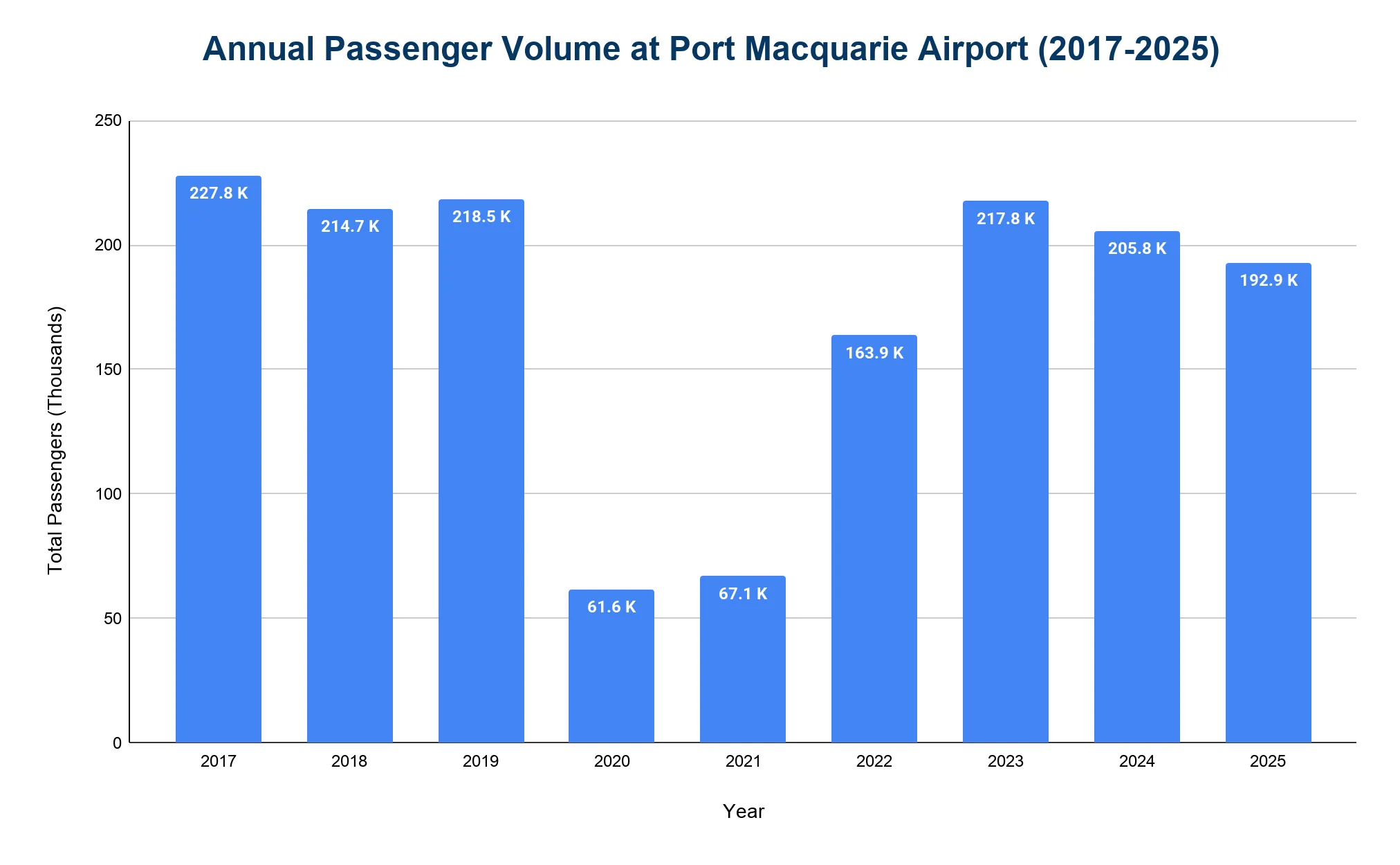
Port Macquarie Airport handles approximately 190,000 to 220,000 passengers annually.
- The airport served 192,863 passengers in 2025, a 6.3% decline from 205,819 in 2024.
- In 2019, before the pandemic, it recorded 218,504 passengers.
- Passenger numbers fell sharply to 61,617 in 2020 (a 72% drop), with a modest increase to 67,080 in 2021.
- Traffic began recovering in 2022 with 163,894 passengers, then reached 217,802 in 2023, nearly matching pre-pandemic levels.
What is the total number of aircraft operations at Port Macquarie Airport each year?
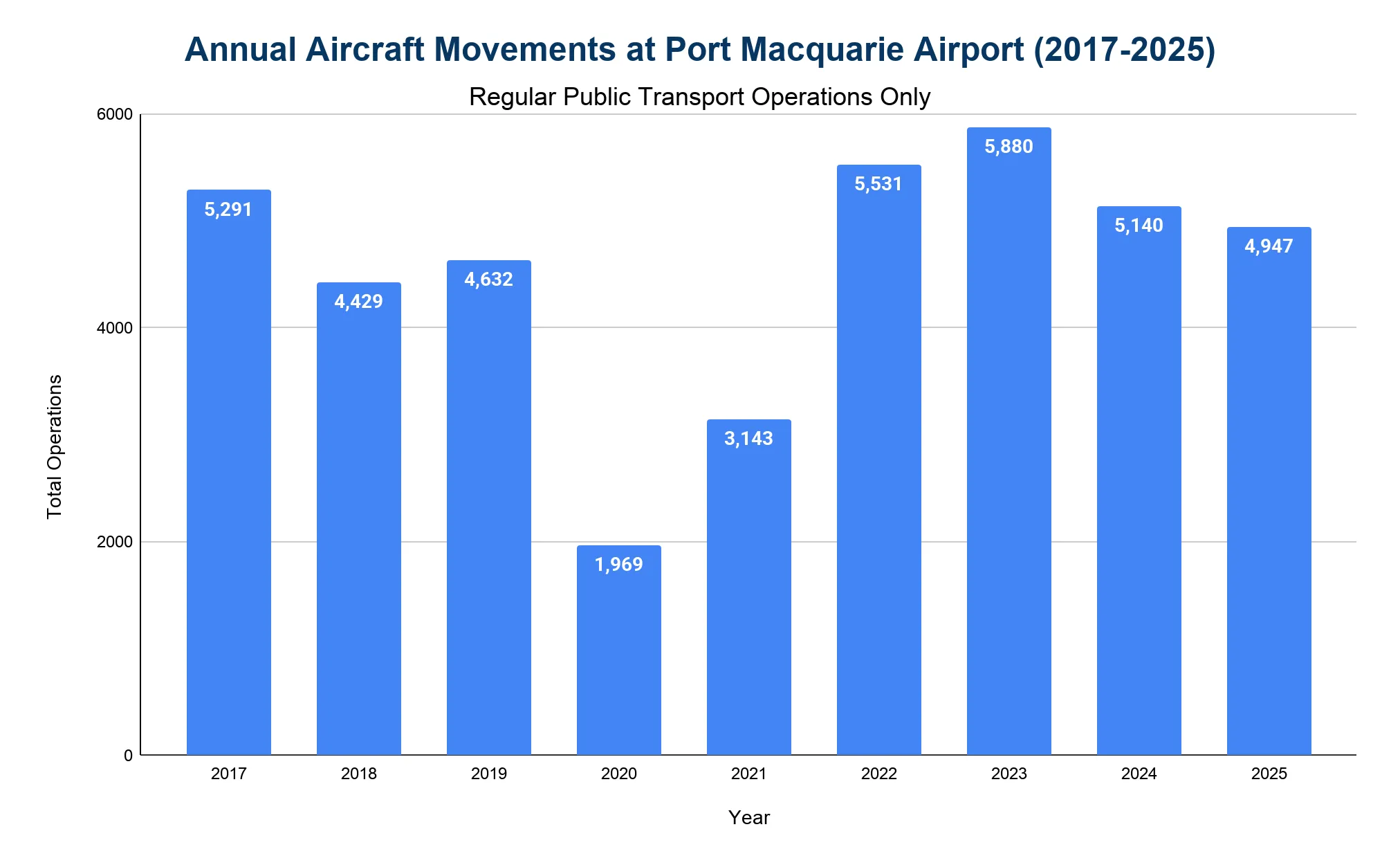
Port Macquarie Airport records approximately 5,000 to 6,000 commercial takeoffs and landings (Regular Public Transport movements) annually.
- In 2025, there were 4,947 RPT movements, representing a 3.8% decline from 5,140 movements in 2024.
- The airport saw 4,632 scheduled route movements in 2019.
- Operations dropped to 1,969 in 2020, the lowest point during the pandemic due to travel restrictions.
- The number rose to 3,143 in 2021, surged to 5,531 in 2022 and peaked at 5,880 in 2023, the highest on record.
Which airlines operate the most flights out of Port Macquarie Airport?
Current scheduled passenger services at PQQ are operated by QantasLink, Rex and Eastern Air Services.
- QantasLink serves Port Macquarie-Sydney and Port Macquarie–Brisbane.
- Rex operates direct Port Macquarie-Sydney services using Saab 340 aircraft.
- Eastern Air Services operates Port Macquarie–Lord Howe Island services.
What are the monthly trends in passenger traffic at Port Macquarie Airport?
Passenger traffic at Port Macquarie Airport remains relatively strong throughout the year, ranging from approximately 14,300 to 18,000 passengers per month in 2025.
- December 2025 was the busiest month, handling around 18,000 passengers, closely followed by October (17,700) and November (17,600).
- Traffic levels were also high during June to September, with monthly passenger numbers consistently exceeding 16,000.
- February recorded the lowest passenger volume at approximately 14,300 passengers, while January (14,500) and May (14,700) also experienced comparatively lower traffic levels.
How many routes are there at Port Macquarie Airport?
- Port Macquarie Airport serves only domestic routes within Australia and does not operate international flights.
- The main route is Port Macquarie-Sydney, with multiple daily turboprop flights.
- The second key route is Port Macquarie-Brisbane, serviced by QantasLink.
- A smaller, niche route to Lord Howe Island is operated by Eastern Air Services using 6-8 seat aircraft.
Which destinations are the most popular from Port Macquarie Airport?
- Sydney, NSW is by far the busiest destination, with 166,595 passengers in 2025, accounting for 86.4% of airport traffic.
- Brisbane, QLD is the second most popular route, serving both business and leisure travel to Queensland.
- Lord Howe Island is served by Eastern Air Services with limited capacity, providing a tourism connection using small aircraft.
How much cargo does Port Macquarie Airport handle annually?
Port Macquarie Airport handles minimal cargo, primarily limited to small shipments on passenger flights.
- There is no dedicated freight airline at PQQ.
- All cargo is transported in the belly holds of QantasLink and Rex aircraft.
- Typical items include overnight parcels, postal mail (Australia Post), medical supplies, and other urgent small shipments.
- Larger freight is usually moved by road to and from Sydney or Brisbane.
On-time performance at Port Macquarie Airport
- At Port Macquarie Airport, overall on-time performance was 70% for arrivals and 77.2% for departures on BITRE-reported routes.
- QantasLink had the best arrival and departure punctuality, with 71.8% of arrivals on time and 77.7% of departures on time.
| Port Macquarie Airport On-time Performance (2025) | ||
|---|---|---|
| Airlines | On Time Arrivals (%) | On Time Departures (%) |
| QantasLink | 71.8 | 77.7 |
| Rex Airlines | 67.4 | 76.5 |
| All Airlines | 70.0 | 77.2 |
What are the main causes of flight disruptions at Port Macquarie Airport?
- Congestion at Sydney Airport and air traffic control delays, where regional flights are deprioritized compared to larger jets.
- Weather, including fog, summer storms and low visibility, which affect small aircraft operations.
- Aircraft positioning issues, where limited fleet availability means delays can affect multiple flights in a day.
- Lack of advanced landing systems, which requires better weather conditions than major airports.
- Operational constraints, such as crew timing limits and the cascading effect of earlier delays.
- Ballina Byron Gateway Airport Statistics
- Darwin International Airport Statistics
- Devonport Airport Statistics
- Hervey Bay Airport Statistics
- Launceston Airport Statistics
- Learmonth Airport (LEA) Statistics
- Mackay Airport (MKY) Statistics
- Merimbula Airport Statistics
- Mildura Airport Statistics
- Newcastle Airport (Australia) Statistics
- Rockhampton Airport Statistics
- Sunshine Coast Airport Statistics
What are the notable incidents at Port Macquarie Airport?
- On 12 April 1985, a Piper PA-31-350, VH-AOX, experienced a reported loss of performance shortly after takeoff from Port Macquarie; the take-off attempt was abandoned and the aircraft force-landed off the end of the runway. There were no fatalities, but the ATSB recorded serious injuries among the occupants.
References
- Australian Airports Traffic Data · bitre.gov.au
- Port Macquarie Airport: Airlines and Destinations · portmacquarieairport.com.au
- ATSB: Incident at Port Macquarie Airport · atsb.gov.au