

 Australia
 New Zealand
 Other Countries
 24/7 Support

Updated
About 8.27 million international tourists visited Australia in 2025 and spent $55.67 billion1, while Australians took another 112.99 million domestic overnight trips2. From large cities such as Sydney and Melbourne to natural wonders like the Great Barrier Reef and Uluru, here is how many people visit, where they come from, where they go and how much they spend.
How many tourists visit Australia each year?
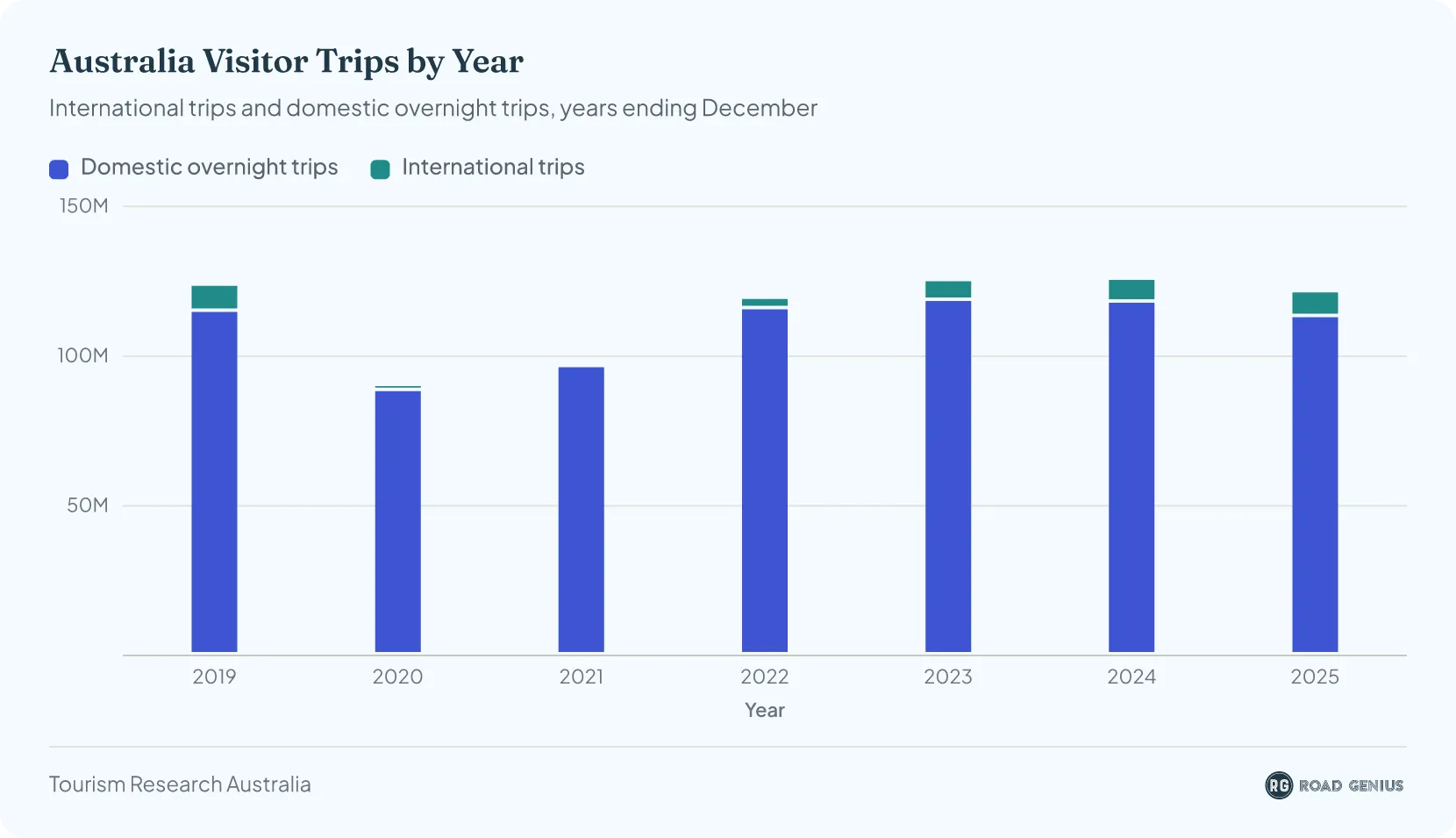
About 8.27 million international tourists visited Australia in 20251, 5% below the 2019 peak of 8.71 million3. Including 112.99 million domestic overnight trips by Australians2, the total was about 121.26 million visitor trips.
- Total visitor trips in Australia reached 123.47 million in 2019 (8.71 million international3, 114.76 million domestic4) before the pandemic struck.
- In 2020, the pandemic caused the total arrivals to drop to 90.04 million visitor trips (1.71 million international5, 88.33 million domestic)4. Overall numbers then recovered slightly in 2021 to 96.50 million (220,000 international5, 96.28 million domestic).4
- By 2022, Australia's tourism sector showed signs of recovery with 119.07 million visitor trips (3.42 million international6, 115.65 million domestic), and in 2023, the total further increased to 125.05 million (6.64 million international, 118.41 million domestic)4, already above pre-pandemic levels.
- The total peaked at 125.47 million in 2024 (7.63 million international1, 117.84 million domestic)4, then eased to 121.26 million in 2025 (8.27 million international, 112.99 million domestic21), about 2% below the 2019 level.
How many international tourists visited Australia in 2025?
About 8.27 million international tourists visited Australia in 2025, up 8% on 20241. Counting domestic overnight trips, the total was about 121.26 million.
- This includes 8.27 million international visitors1 (still 5% below the 2019 level) and 112.99 million domestic overnight trips2 (down 4% on 2024).
- Australia recorded 761,230 short-term visitor arrivals in March 2025, almost unchanged from March 2024 (up just 190)7.
How many people visited Australia in 2024?
About 7.63 million international tourists visited Australia in 2024. Counting domestic overnight trips, the total was about 125.47 million.
- This includes 7.63 million international visitors1 (still 12% below the pre-pandemic peak) and 117.84 million domestic overnight trips (above the 2019 level)4.
How many tourists visited Australia in 2023?
About 6.64 million international tourists visited Australia in 20236. Counting domestic overnight trips, the total was about 125.05 million.
How many tourists have visited Australia in 2026 so far?
About 5.77 million short-term visitor arrivals were recorded in Australia from January to August 2026, 2% more than in the same months of 20258.
- February 2026 was the busiest month so far with 943,220 arrivals, while June (566,910) was the quietest. August 2026 recorded 755,530 arrivals, 0.3% up on August 2025 but still 4.3% below August 20198.
- In the year ending June 2026, international visitors made 8.43 million trips to Australia (up 9%) and spent $56.96 billion (up 12%)9.
- Domestic overnight trips fell 2% to 27.1 million in the June quarter 2026, while overnight spending rose 2% to $25.7 billion10.
Full-year 2026 results are due in early 2027.
How much do visitors spend in Australia every year?
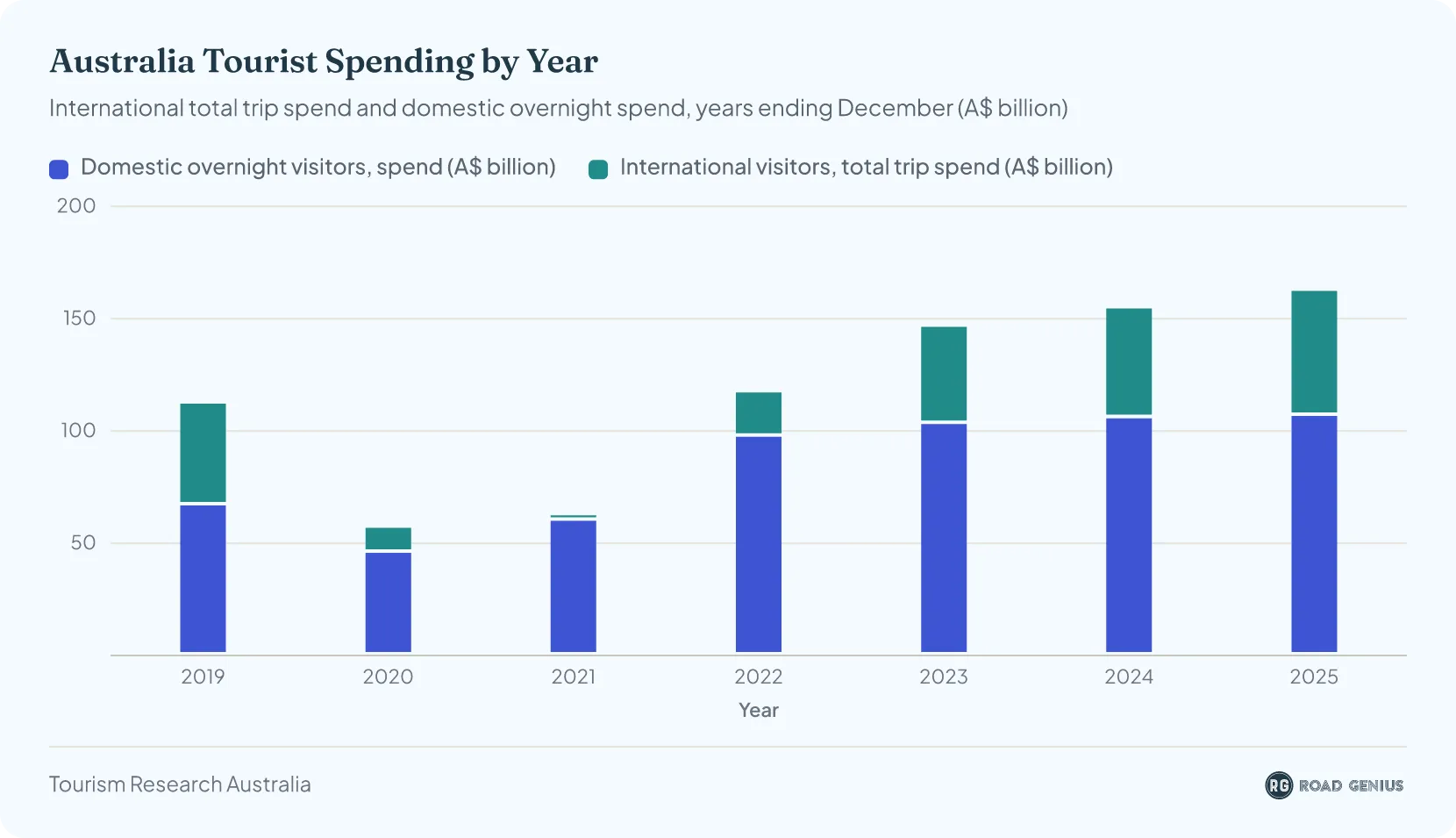
Visitors spent a record $162.42 billion in Australia in 2025, 5% more than in 2024 and 45% above pre-pandemic 2019.
- In 2019, total visitor spending reached $112.21 billion ($45.38 billion international, $66.83 billion domestic4) before the pandemic impacted global travel.
- Mirroring the decrease in tourist arrivals, total visitor spending dropped to $56.85 billion in 2020 ($11.07 billion international, $45.78 billion domestic4), followed by an increase to $62.48 billion in 2021 ($2.43 billion international, $60.05 billion domestic).
- By 2022, tourism spending rebounded to $117.22 billion ($19.76 billion international, $97.46 billion domestic4), already about 4% above the 2019 level.
- In 2024, total visitor spending climbed to $154.56 billion ($48.87 billion international1, $105.69 billion domestic4), and in 2025 it reached a record $162.42 billion, comprising $55.67 billion from international visitors1 and $106.75 billion from domestic overnight visitors2, 45% above the pre-pandemic level of 2019.
- The $162.42 billion total excludes domestic day trips. Counting day trips ($46.41 billion), domestic visitors spent $153.16 billion in 20252.
How much does Australia earn from tourism?
Tourism earned Australia a record $162.42 billion in visitor spending in 2025, 45% more than in pre-pandemic 2019, and added $81.1 billion directly to GDP in 2024-25.
How much does tourism add to Australia's economy?
- Tourism's direct Gross Domestic Product (GDP) was $81.1 billion in current prices for the 2024-25 financial year, a 3.8% increase from the previous year11.
- Tourism directly supported 696,000 filled jobs in 2024-25, up 2.0% on the year and equal to 4.4% of all jobs, or about 1 in every 23 jobs in Australia11.
How much does it cost to visit Australia?
The average visitor spending per capita in Australia varies significantly between international and domestic tourists, with an overall average of $1,339 per visitor in 2025.
Where do visitors to Australia come from?
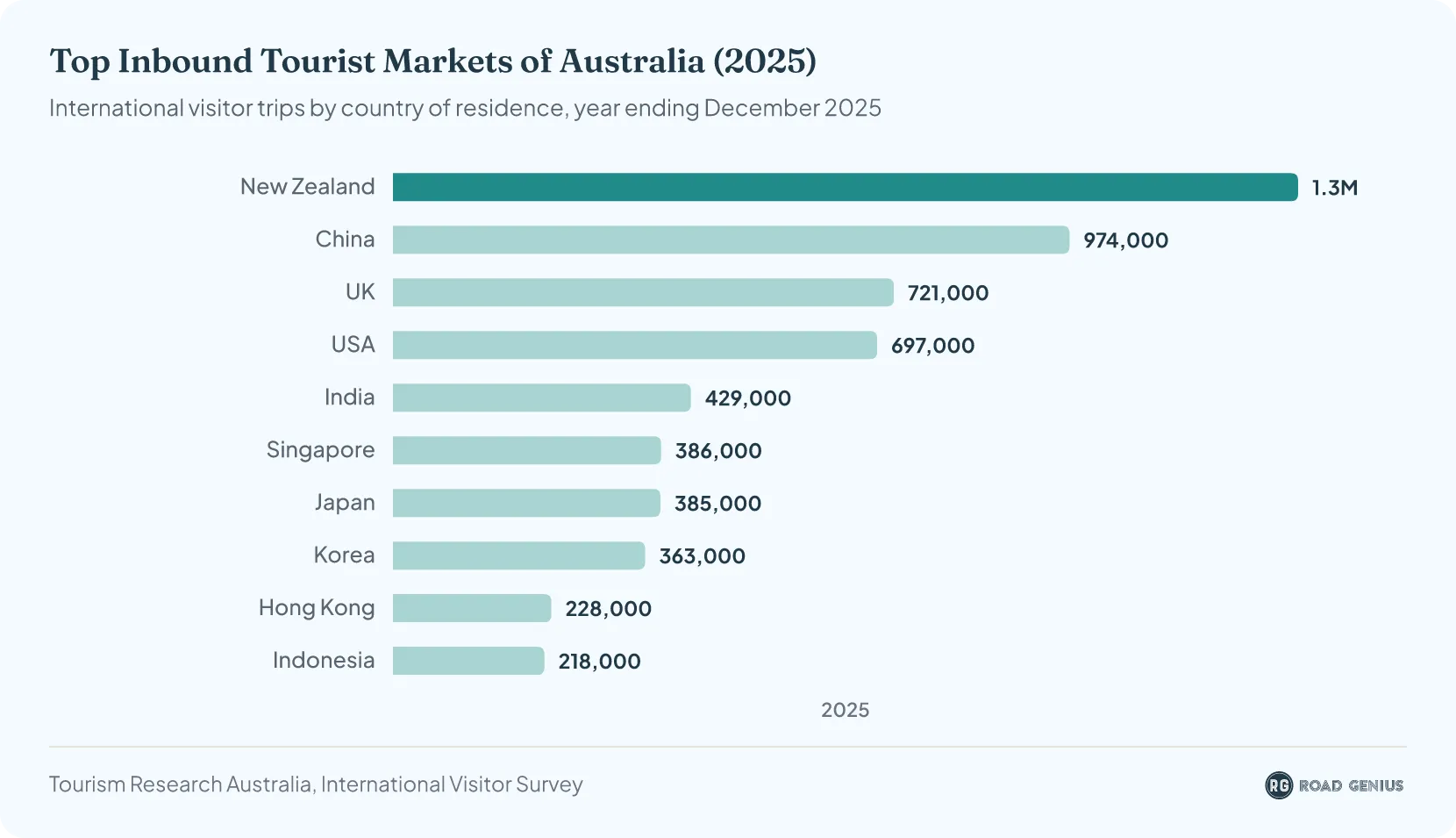
New Zealand is the leading source of international visitors to Australia, with a total of 1.30 million tourists in 20251.
- This was followed by China with 974,000 tourists1. The United Kingdom (721,000), the United States (697,000), and India (429,000) also contributed a significant share of the market. Singapore (386,000), Japan (385,000), Korea (363,000), Hong Kong (228,000) and Indonesia (218,000) were also among Australia's larger markets.
Which states and cities do tourists visit most?
New South Wales is the most visited state in Australia, with 4.11 million international visitors1 and 39.2 million domestic overnight trips in 20252.
- Victoria ranked second with 2.83 million international visitors and 31.4 million domestic overnight trips, followed by Queensland (2.37 million international1, 25.9 million domestic)2.
- Western Australia had the fastest growth in international visitors, up 23% to 1.07 million in 20251.
- Sydney is the most visited city for international tourists, with 3.82 million visitors in 2025, followed by Melbourne (2.65 million), Brisbane (1.33 million), Perth (1.01 million) and the Gold Coast (682,000)1.
- Adelaide (404,000), Hobart (235,000), Canberra (199,000) and Darwin (143,000) received fewer international visitors1.
How long do visitors stay in Australia?
Why do people visit Australia?
Holidays are the main reason people visit Australia, accounting for 3.58 million international trips (43%) in 20251.
- Visiting friends and relatives was the second most common reason, with 2.78 million trips (34%)1.
- Business travellers made 758,000 trips, down 3% on 2024, while education trips rose 11% to 540,0001.
- Education visitors spent $14.48 billion in Australia, more than holidaymakers ($12.92 billion)1, because students stay much longer.
- Road trips are a big draw for Australians: they took a record 17.3 million caravan and camping trips in 2025, up 14%, and 77% of them were holidays12.
Car and campervan hire in Australia
Where does Australia rank among the world's tourist destinations?
- International arrivals grew 8% in 2025 to 8.27 million1, though they remain 5% below the 2019 level.
- In 2024, Australia ranked 5th globally in the World Economic Forum's Travel and Tourism Development Index13.
- The country also performed well in terms of revenue, with total visitor spending of $162.42 billion in 2025, which exceeded pre-pandemic levels by 45%.
- Additionally, Australia's tourism sector contributed $81.1 billion to the direct GDP in 2024-25, accounting for 2.9% of the total Australian economy11.
What is the busiest month for tourism in Australia?
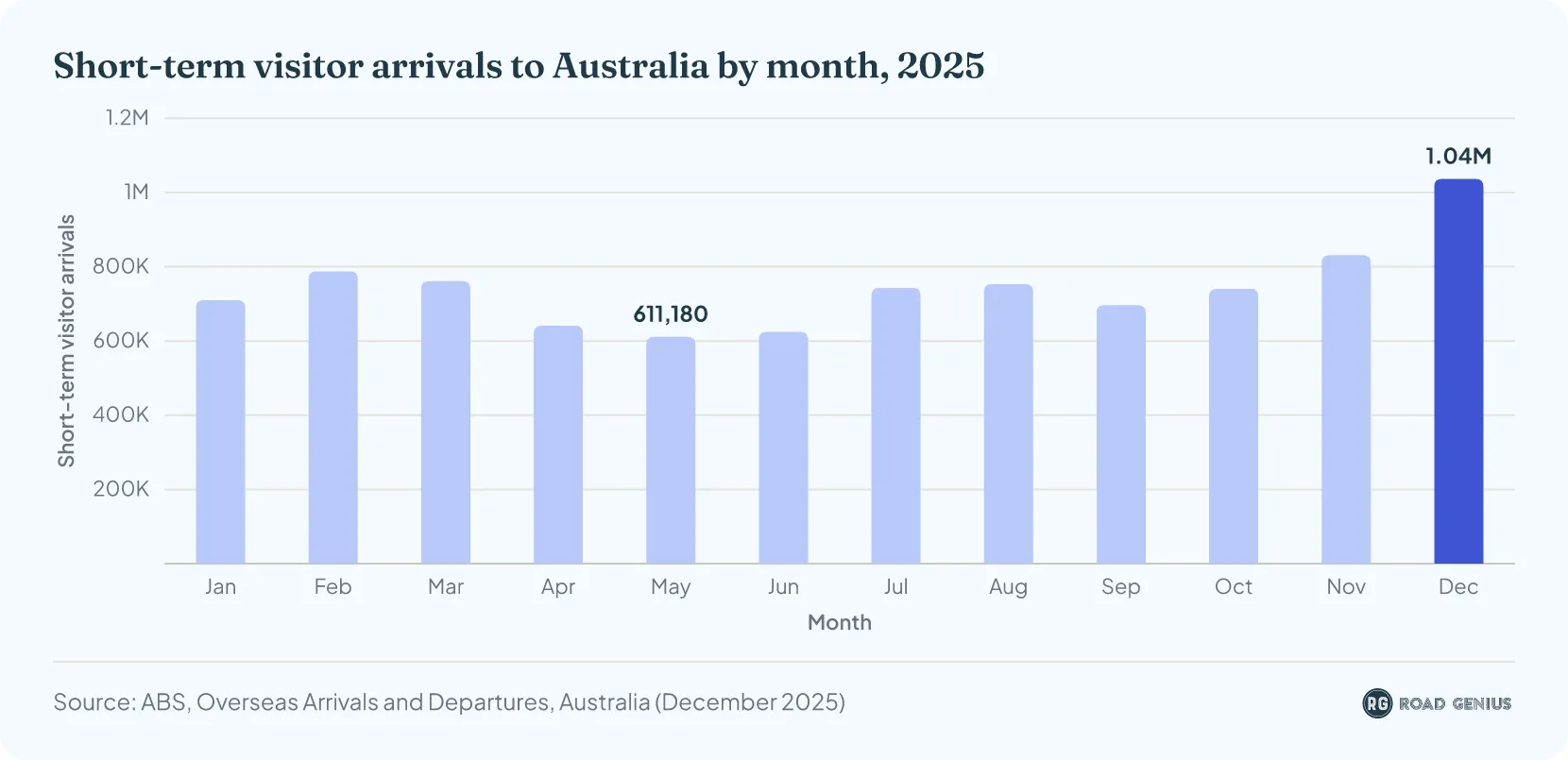
December is the busiest month for international tourists in Australia, with 1.04 million short-term visitor arrivals in December 202514.
- November (831,000) and February (788,000) were the next busiest months for international arrivals, while May (611,000) and June (625,000) were the quietest14.
- For domestic travel, the December quarter was the busiest in 2025 with 29.5 million overnight trips, ahead of the March quarter (28.8 million)2.
When is the best time to visit Australia?
- Summer (December to February) is the most popular time, offering warm weather and numerous outdoor activities. This is ideal for exploring beaches, cities, and many national parks.
- Autumn (March to May) and Spring (September to November) are also good times, with pleasant weather, fewer crowds, and beautiful seasonal changes.
- Winter (June to August) varies significantly across the continent – ideal for tropical regions like Queensland, while southern areas experience cooler temperatures.
When is the best time to visit the Great Barrier Reef?
The dry season (May to October) brings the best diving and snorkelling conditions, with the clearest water from June to August. See Great Barrier Reef tourism statistics for visitor numbers.
Has Australian tourism recovered from COVID?
Tourism spending in Australia has fully recovered from COVID-19, but international and domestic visitor numbers are still slightly below 2019.
- International arrivals reached 8.27 million in 20251, still 5% below the 2019 level of 8.71 million3, after falling to just 220,000 in 20215.
- Domestic overnight trips reached 112.99 million in 2025, about 2% below the revised 2019 level of 114.76 million4.
- Total visitor spending hit a record $162.42 billion in 202521, 45% above 2019, after falling 49% to $56.85 billion in 2020.
Most visited tourist attractions in Australia
- Sydney Opera House, New South Wales: The Sydney Opera House attracts about 10.9 million visitors annually15 and staged 1,832 performances in 2024–2516.
- Great Ocean Road, Victoria: The Twelve Apostles alone draw around 2.8 million visitors a year17.
- Bondi Beach, New South Wales: About 2.9 million domestic overnight and international visitors went to Bondi Beach in 202518.
- Great Barrier Reef, Queensland: The world’s largest coral reef system received about 2.38 million visitors in 202519, drawn by diving, snorkelling and its marine life.
- Uluru-Kata Tjuta National Park, Northern Territory: Home to Uluru and Kata Tjuta, this UNESCO World Heritage site received about 267,000 visitors in 2024–2520. It is recognised for its cultural and spiritual significance.
- Rottnest Island, Western Australia: The island is one of Western Australia’s best-known day trips, with many drawn by its beaches and unique wildlife, including the quokka.
Other Tourism Statistics
- Australia–Indonesia Travel Statistics
- Australia–USA Travel Statistics
- Bondi Beach Tourism Statistics
- Brisbane Tourism Statistics
- Byron Bay Tourism Statistics
- Canberra Tourism Statistics
- Great Barrier Reef Tourism Statistics
- Noosa Tourism Statistics
- Sea World Australia Tourism Statistics
- Sydney Harbour Bridge Tourism Statistics
- Sydney Opera House Tourism Statistics
- Uluru Tourism Statistics
References
- International tourism results — year ending December 2025 (International Visitor Survey) · Tourism Research Australia ↑ b c d e f g h i j k l m n o p q r s t u v w x y
- Domestic Tourism Statistics results — December quarter 2025 (Tourism Research Australia) · Tourism Research Australia ↑ b c d e f g h i j k l
- International visitation and expenditure, year ending December 2019 (Business Victoria / Tourism Research Australia International Visitor Survey) · business.vic.gov.au ↑ b c
- Tourism Research Australia — Domestic Tourism Statistics: 2019–2024 overnight backcast data (revised) · Tourism Research Australia ↑ b c d e f g h i j k l
- International Visitor Survey tourism results — year ending December 2021 compared with 2020 (Tourism Research Australia) · Tourism Research Australia ↑ b c
- International Visitor Survey tourism results — year ending December 2023 compared with 2022 (Tourism Research Australia) · Tourism Research Australia ↑ b c
- Overseas Arrivals and Departures, Australia, March 2025 · Australian Bureau of Statistics ↑
- Overseas Arrivals and Departures, Australia, August 2026 · Australian Bureau of Statistics ↑ b
- International tourism results — year ending June 2026 (International Visitor Survey) · Tourism Research Australia ↑
- Domestic Tourism Statistics — June quarter 2026 (Tourism Research Australia) · Tourism Research Australia ↑
- Australian National Accounts: Tourism Satellite Account, 2024-25 · Australian Bureau of Statistics ↑ b c
- Other: Car Rental, EV rental, Fuel Cost, Road Trips — Road Trips Australia (2025)#how-many-road-trips-are-taken-dcf4bd · Tourism Research Australia ↑
- Travel & Tourism Development Index 2024 — World Economic Forum · www3.weforum.org ↑
- Overseas Arrivals and Departures, Australia, December 2025 · Australian Bureau of Statistics ↑ b
- Sydney Opera House — Facts About the Sydney Opera House · sydneyoperahouse.com ↑
- Sydney Opera House Annual Report 2024–25 · parliament.nsw.gov.au ↑
- Twelve Apostles Precinct Redevelopment — Community engagement summary report 2023 (Development Victoria) · development.vic.gov.au ↑
- Bondi Visitor Profile — year ending December 2025 (Destination NSW, from Tourism Research Australia data) · cdn.sanity.io ↑
- Great Barrier Reef Marine Park tourism visitation data (Reef Authority, EMC logbooks) · Great Barrier Reef Marine Park Authority ↑
- Director of National Parks Annual Report 2024–25 · dcceew.gov.au ↑
- Tourism Research Australia — International visitor data · Tourism Research Australia
- Overseas Arrivals and Departures, Australia, August 2019 · Australian Bureau of Statistics
- Economic Impact of Coronavirus on Australian Tourism · ttf.org.au

