

 Australia
 New Zealand
 Other Countries
 24/7 Support
Updated
Brisbane is the capital of Queensland and Australia's third-largest city. Visitors are drawn to its subtropical climate, local culture, and well-known destinations like the Great Barrier Reef and the Gold Coast.
How many people visit Brisbane each year?
Over 9 million tourists visit Brisbane each year.
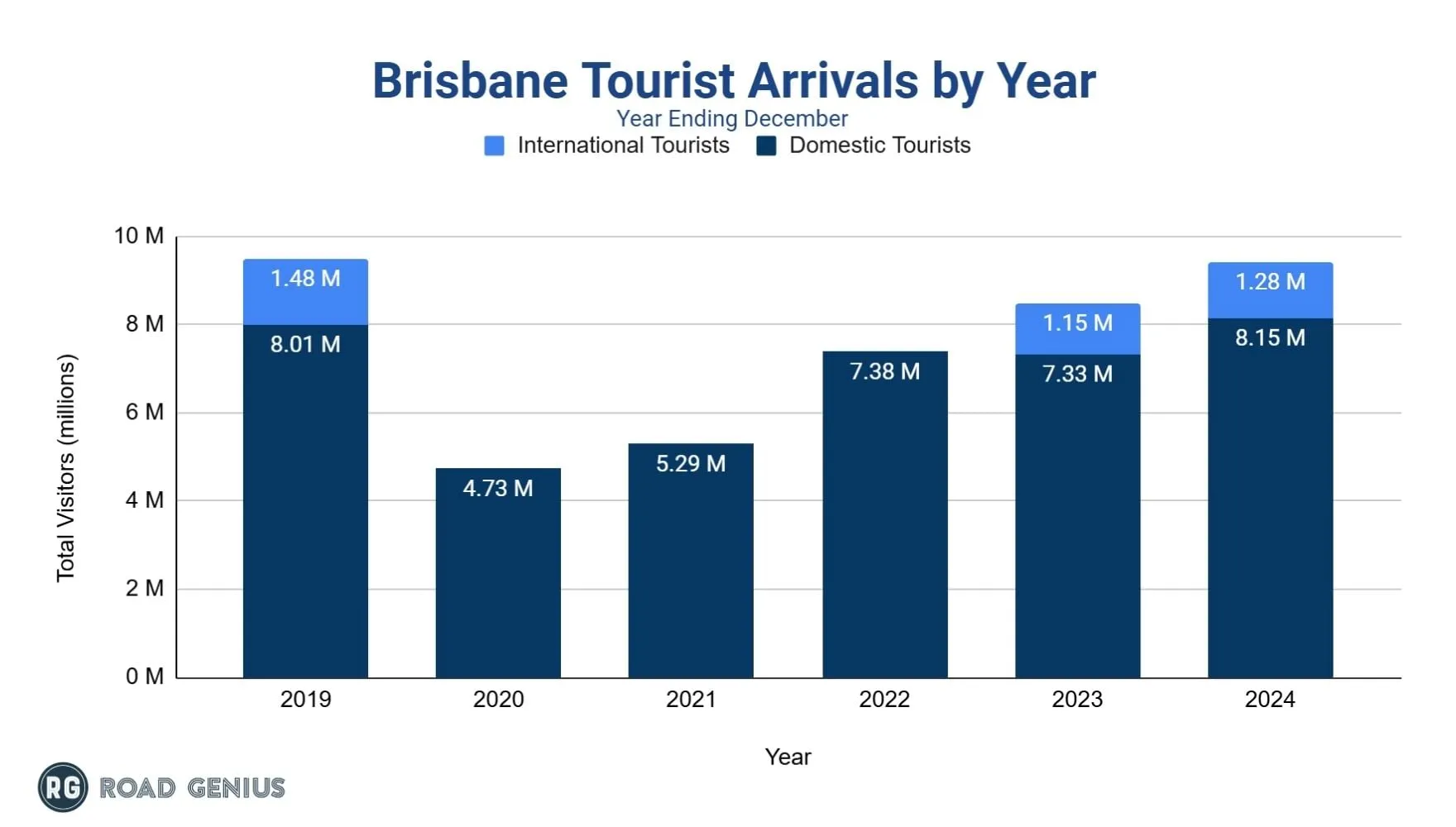
- Over 9.43 million tourists travelled to Brisbane in 2024, combining international (1.28 million) and domestic (8.15 million) visitors.
- This total shows an approximately 14% decrease in international trips from 1.48 million in 2019 and an approximately 11% increase in domestic trips from 7.33 million in 2023.
How many people visited Brisbane in 2024?
- In the year ending December 2024, Brisbane welcomed approximately 8.15 million domestic visitors, marking an 11.2% increase from the previous year and reaching 1.7% above 2019 figures.
How many people visited Brisbane in 2023?
- In the year ending December 2023, Brisbane welcomed approximately 7.33 million domestic visitors, marking a 0.7% decrease from 7.38 million in 2022 but still trailing 8.5% behind 2019 figures.
How many people visited Brisbane in 2019?
- The city saw over 8.01 million domestic visitors in the year ending December 2019.
How much do visitors spend in Brisbane every year?
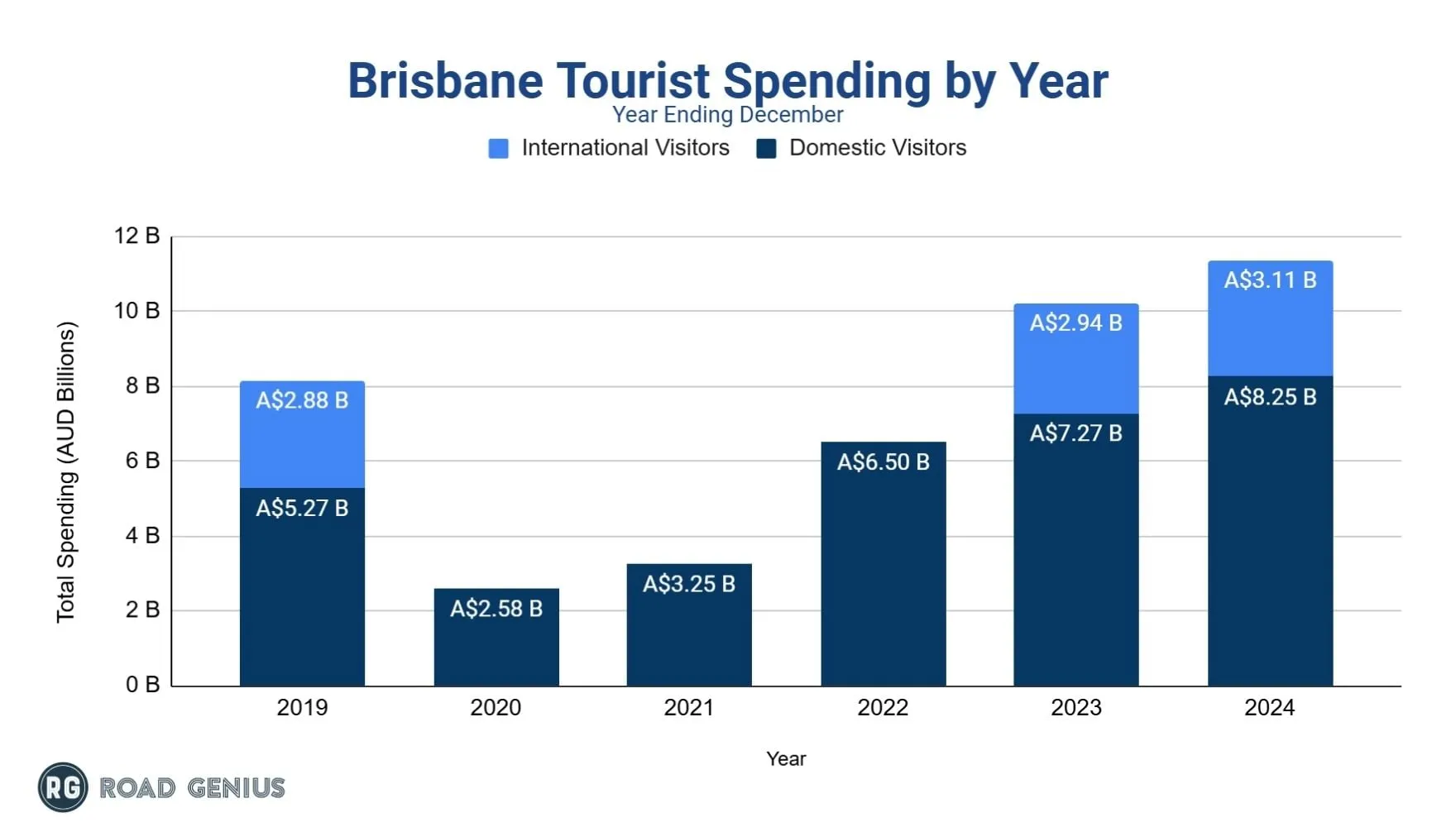
Tourists spent $11.36 billion in Brisbane in the year ending December 2024, with international visitors spending $3.11 billion and domestic visitors spending $8.25 billion.
- This expenditure represents an 8% increase in international spending from $2.88 billion in 2019 and a 13.5% increase in domestic spending from $7.27 billion in 2023.
How much did visitors spend in Brisbane in 2024?
Domestic tourism in 2024 (year ending December) generated over $8.25 billion in revenue. This reflected a growth of 13.5% from 2023 and an approximately 57% increase from 2019.
- For international tourists, expenditure reached $3.11 billion, up by approximately 6% from 2023 and 8% from 2019.
How much did visitors spend in Brisbane in 2023?
Domestic tourism in 2023 (year ending December) generated over $7.27 billion in revenue. This reflected a growth of 11.8% from 2022 and a substantial 38% increase from 2019.
- For international tourists, expenditure reached $2.94 billion, up by 2.1% from 2019.
What is the average cost to visit Brisbane?
For a typical 3-day domestic trip, visitors can expect to spend approximately $800 per person, including flights, accommodation, food, transport, and activities.
- Airfare costs for domestic travelers range from $150-$300 round-trip from Sydney or Melbourne. International flights start around $1,300-$1,600 from Los Angeles and $1,500-$1,800 from London.
- Accommodation prices average $90-$120 per night for 3-star hotels and $150-$180 per night for 4-star properties. Backpacker dorm beds are available from $30-$40 per night.
- Daily food budget should be around $50-$70 per day, with breakfast costing about $15, lunch $15-$20, and dinner $25-$40 at casual restaurants.
- Transport costs are reasonable with daily public transport (buses, CityCat ferries, trains) capped at under $10 per day. Airport rideshare costs approximately $45.
- Activity expenses vary widely, with many attractions being free (South Bank, Mt Coot-tha hiking). Paid attractions include Lone Pine Koala Sanctuary ($49 adult entry) and Story Bridge climb ($130). Budget $100-$150 for miscellaneous attractions and tours.
Where do visitors to Brisbane come from?
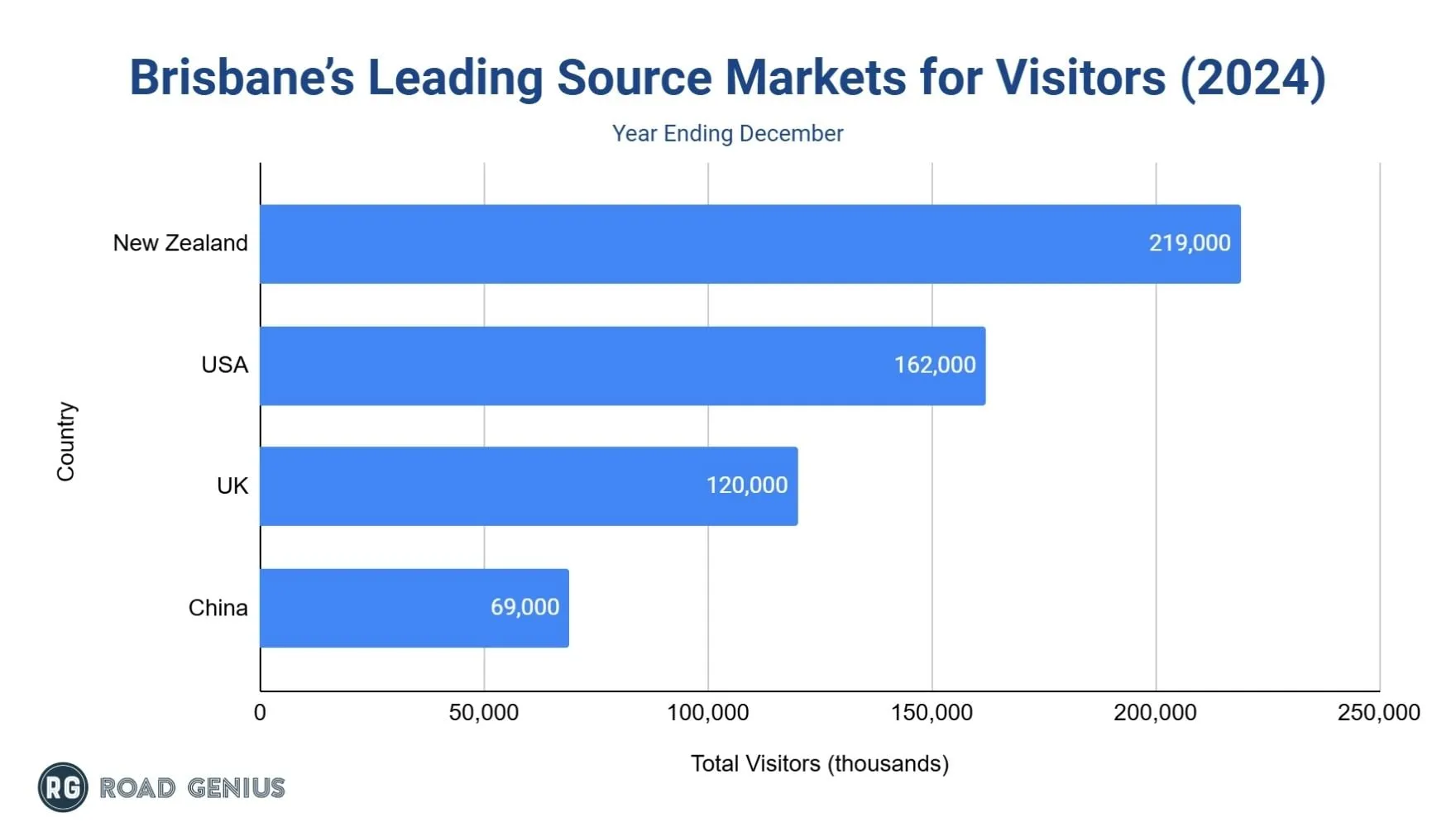
Brisbane received visitors from various locations, primarily from within Australia, with Sydney contributing 1.1 million visitors and Melbourne 772,000 visitors in 2024.
- The city also attracted international visitors, including 219,000 from New Zealand, 162,000 from the USA, 120,000 from the UK, and 69,000 from China, alongside growing visitor numbers from Canada and Indonesia.
Impact of Coronavirus - Brisbane Tourism Statistics 2020
In the year ending December 2020, Brisbane's domestic tourism visitor numbers dropped to 4.73 million, and spending fell to $2.58 billion.
- This represented a 41% decrease in domestic visitors compared to 8.01 million in 2019, with domestic spending down by 51% from $5.27 billion in 2019.
Brisbane and the Gold Coast Tourism Statistics 2024
In the year ending December 2024, Brisbane and the Gold Coast combined attracted over 14.36 million visitors, generating $18.29 billion in total spending.
- Brisbane welcomed 9.43 million visitors (1.28 million international and 8.15 million domestic) who spent $11.36 billion
- The Gold Coast received 4.93 million visitors (0.64 million international and 4.29 million domestic) who spent $6.93 billion
- Combined, the region showed strong growth with Brisbane's visitor numbers up 11% and total spending up approximately 14% from 2023, while the Gold Coast saw visitor numbers increase 3.6% and spending rise 5.1% from the previous year
When is the best time to visit Brisbane?
The autumn (March-May) and spring (September-November) months are widely regarded as the best times to visit Brisbane.
- During these periods, the weather is warm and sunny (mid-20s °C) with low humidity, allowing visitors to enjoy outdoor attractions comfortably.
- April and May often hit the sweet spot for pleasant weather and fewer crowds.
- Summer (December-February) is hot, humid, and brings tropical storms, but it's also a festive time with holiday events and New Year's Eve celebrations.
- Winter (June-August) is generally mild with daytime temperatures around 20°C and cooler nights, making it a great time for sightseeing and day trips. Brisbane hosts the Royal Queensland Show (Ekka) in August during this season.
- September is popular due to the Brisbane Festival featuring light shows, music, and arts events.
How popular is Brisbane as a tourist destination?
How long do international tourists stay in Brisbane?
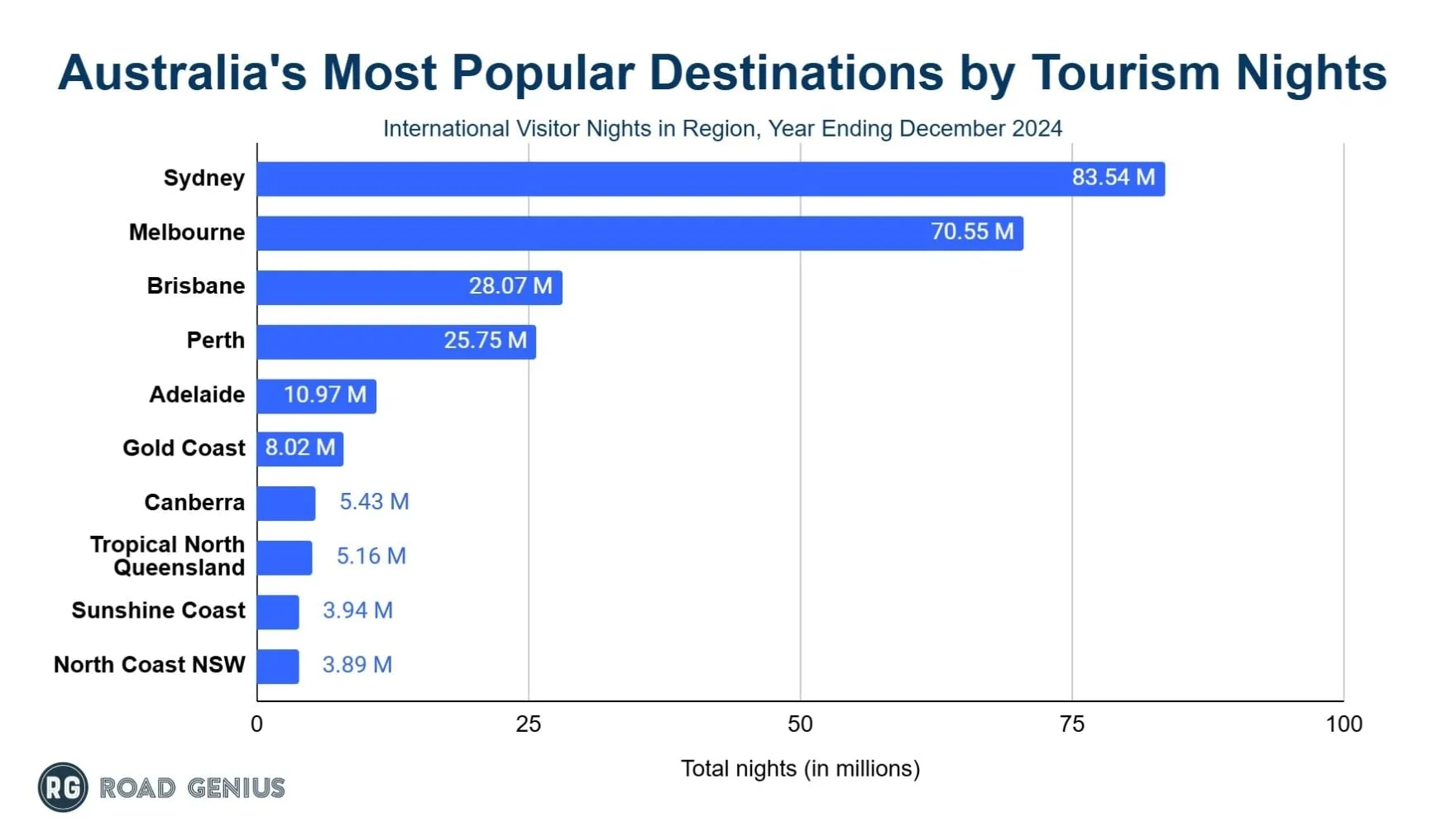
- Brisbane's domestic overnight visitors stay about 3.1 nights on average, while international visitors tend to stay much longer, at an average of 22 nights.
- Bondi Beach Tourism Statistics
- Canberra Tourism Statistics
- Great Ocean Road Tourism Statistics
- Perth Tourism Statistics
- Sea World Australia Tourism Statistics
- Sunshine Coast Tourism Statistics
- Sydney Tourism Statistics
- Sydney Harbour Bridge Tourism Statistics
- Sydney Opera House Tourism Statistics
- Toowoomba Tourism Statistics
- Uluru Tourism Statistics
- Whitsunday Islands Tourism Statistics
Why do tourists visit Brisbane?
Brisbane offers an appealing mix of laid-back charm and urban energy, with a strong focus on outdoor living and easy access to iconic destinations.
- Visitors are drawn to South Bank Parklands, a riverside precinct with gardens, a lagoon beach and cultural institutions including Queensland Art Gallery & GOMA and Queensland Museum.
- The city's vibrant cafe and brewery scene in Fortitude Valley and West End attracts food and beverage enthusiasts.
- Outdoor adventures are popular, including climbing the Story Bridge, cruising the Brisbane River, and hiking Mt Coot-tha for panoramic city views.
- Wildlife experiences draw many tourists to the Lone Pine Koala Sanctuary, where visitors can cuddle koalas and interact with native Australian animals.
- Brisbane's calendar of sporting events at The Gabba (cricket and AFL) and Suncorp Stadium (rugby) brings sports fans throughout the year.
- The city serves as a gateway to iconic destinations like the Gold Coast and Great Barrier Reef, making it an ideal base for exploring Queensland.
- Cultural events, including the Brisbane Festival in September, featuring light shows, music, and arts, attract visitors seeking cultural experiences.
Top Attractions in Brisbane
- The Great Barrier Reef: While located off the coast of Queensland, the Great Barrier Reef is a frequent destination for visitors to Brisbane. It can be explored via a 30-minute helicopter flight, which also covers Whitehaven Beach and Hill Inlet. The Reef receives over 2 million visitors annually.
- The Gold Coast: Known for its beaches, surfing spots, and theme parks such as Warner Bros. Movie World and Sea World, the Gold Coast attracts more than 12 million visitors each year.
- Lone Pine Koala Sanctuary: Home to over 130 koalas, this sanctuary allows visitors to feed kangaroos. It sees around 500,000 visitors annually.
- South Bank: A cultural and recreational area featuring attractions like the Wheel of Brisbane, Streets Beach, and numerous dining options, South Bank welcomes over 10 million visitors each year.
- Mt. Coot-tha: Offering panoramic views of the city, Mt. Coot-tha is a popular destination for both tourists and locals, drawing approximately 1.5 million visitors annually.