

 Australia
 New Zealand
 Other Countries
 24/7 Support
Published
Australia’s electric car rental market is expanding inside a larger AUD 3 billion passenger car rental and hiring industry, supported by rising electric vehicle adoption, larger public charging networks, airport-heavy travel demand, and company-backed electric fleet rollouts.
How large is Australia’s car rental market?
Australia’s passenger car rental and hiring industry is valued at AUD 3 billion in 2026, with 3,802 businesses operating in 2025.
- Industry revenue grew at a 1.4% compound annual growth rate (CAGR) between 2020 and 2025.
- Business numbers grew faster than revenue, rising at a 10.1% CAGR over the same period.
- The wider market includes passenger car rental, long-term rental, and operating leases for passenger cars, SUVs, and minibuses.
- Electric car rentals sit within this wider rental base as battery electric vehicles (BEVs) and plug-in hybrid electric vehicles (PHEVs) become more common in Australian fleets.
Note: The AUD 3 billion market-size figure covers the broader passenger car rental and hiring industry, including internal combustion engine (ICE), hybrid, and electric vehicles.
How fast is Australia moving toward electric vehicles?
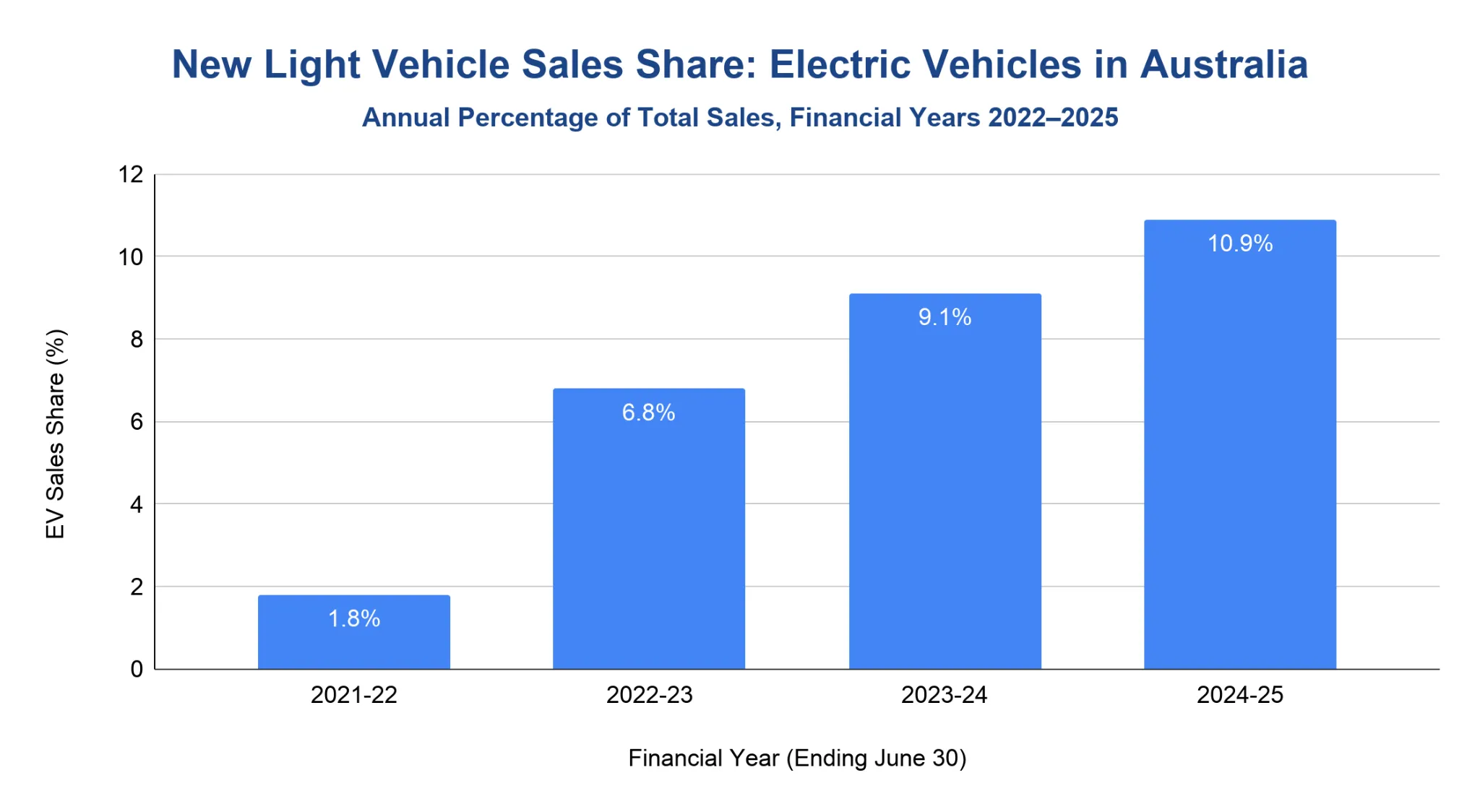
Electric vehicles (EVs) accounted for 10.9% of new light vehicle sales in Australia in FY2024-25, compared with 1.8% in FY2021-22.
- EV sales share increased by 9.1% between FY2021-22 and FY2024-25.
- Nearly 128 thousand EVs were sold in Australia during FY2024-25.
- BEVs accounted for 87,500 sales in FY2024-25, equal to 7.4% of all new light vehicle sales.
- PHEVs accounted for 40,500 sales in FY2024-25, equal to 3.4% of all new light vehicle sales.
- EV model availability reached 153 models by June 2025, up from 104 in FY2023-24 and 56 in FY2021-22.
- More affordable EV choice also increased, with 55 EV models priced below AUD 60,000 by mid-2025, up from 33 in FY2023-24.
Note: EV sales share means BEV and PHEV sales divided by total new light vehicle sales. BEVs are fully electric, while PHEVs combine external charging with a combustion engine. Data shown for financial years ending on June 30 each year.
How many electric rental vehicles are being added in Australia?
Australia’s largest public electric rental fleet rollouts include more than 500 BYD EVs announced by SIXT in 2023 and at least 3,093 BEVs planned through Europcar’s ARENA-backed rollout to 2028.
- SIXT’s first 200 BYD vehicles were scheduled to arrive in April 2023.
- Europcar’s rollout is larger in scale, with the planned BEV count more than 6 times SIXT’s announced BYD volume.
- Europcar’s Australian Renewable Energy Agency (ARENA) project also includes 256 chargers across at least 41 Australian locations.
- The Europcar project runs from 13 December 2023 to 31 March 2028.
- Rental fleet electrification depends on both vehicle supply and branch-level charging capacity, especially for fast turnarounds between bookings.
Note: Rental fleet rollouts usually enter service in stages. Charging infrastructure installed at rental branches helps operators prepare vehicles between bookings and supports smoother customer handovers.
Cost to Rent an Electric Car in Australia
Public electric rental prices in Australia range from around AUD 75/day for a Tesla Model 3 on evee (a peer-to-peer EV network) to AUD 90/day for SIXT’s BYD EV launch quote.
- Avis requires EVs to be returned with at least 80% charge to avoid a recharge fee.
- Avis lists an estimated EV driving range of up to 430 km at full charge and separately cites around 300 km at 80% charge.
- Budget lists EV driving range of up to 450 km from a full charge.
| Provider / Platform | Vehicle Example | From Price (AUD/day) |
|---|---|---|
| evee | Tesla Model 3 | 75 |
| evee | Tesla Model Y | 85 |
| SIXT | BYD EV | 90 |
Source · Note: The table compares quoted “from” daily prices, not total trip cost. Rental prices can change by city, branch, booking date, vehicle model, rental length, taxes, fees, and availability.
How strong is the overall car rental demand in Australia?
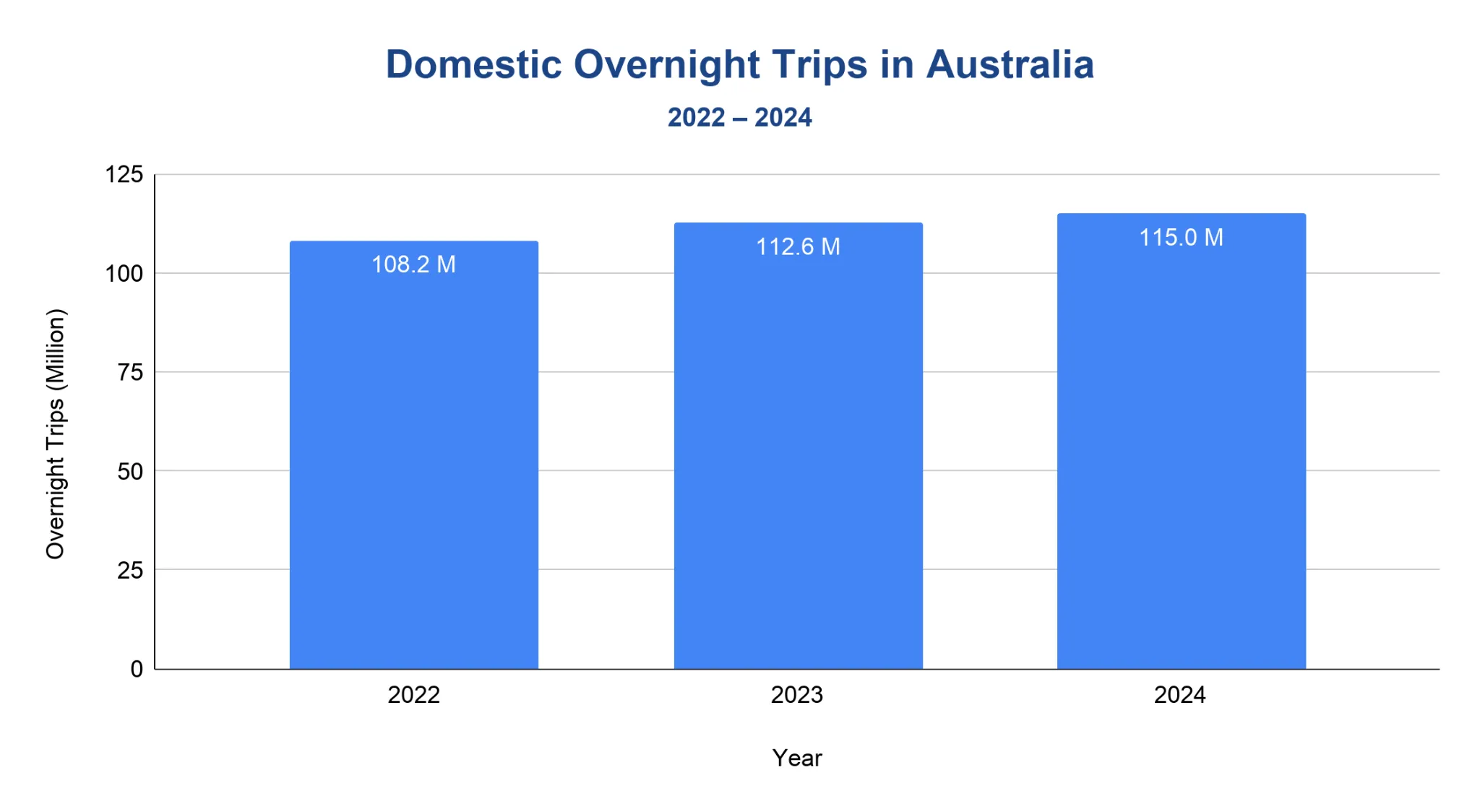
Australia’s overall car rental demand is supported by a AUD 3 billion passenger car rental and hiring market in 2026 and 115 million domestic overnight trips in 2024.
- Domestic overnight trips increased from 108.2 million in 2022 to about 112.6 million in 2023, then 115 million in 2024.
- Domestic overnight trip volume rose by about 6.8 million trips between 2022 and 2024.
- Domestic overnight visitor spend reached AUD 110.3 billion in 2024, up 1% from 2023.
- Australia’s passenger car rental and hiring industry had 3,802 businesses in 2025, with business numbers growing at a 10.1% compound annual growth rate (CAGR) between 2020 and 2025.
- Airport travel remains an important part of the rental market, with domestic commercial aviation carrying 63.77 million passengers in the year ending June 2025. However, passenger movements should be read as a travel-demand indicator rather than a direct rental-booking count.
- International trips to Australia reached 7.6 million in 2024, equal to 88% of the 2019 level, adding further demand potential for rental providers in gateway and tourism markets.
Note: Domestic overnight trips are a travel-demand indicator, not a direct count of rental bookings. They are useful for this section because car rentals are commonly linked to overnight leisure, business, visiting-friends-and-relatives, and regional travel.
Is Australia ready for electric car road trips?
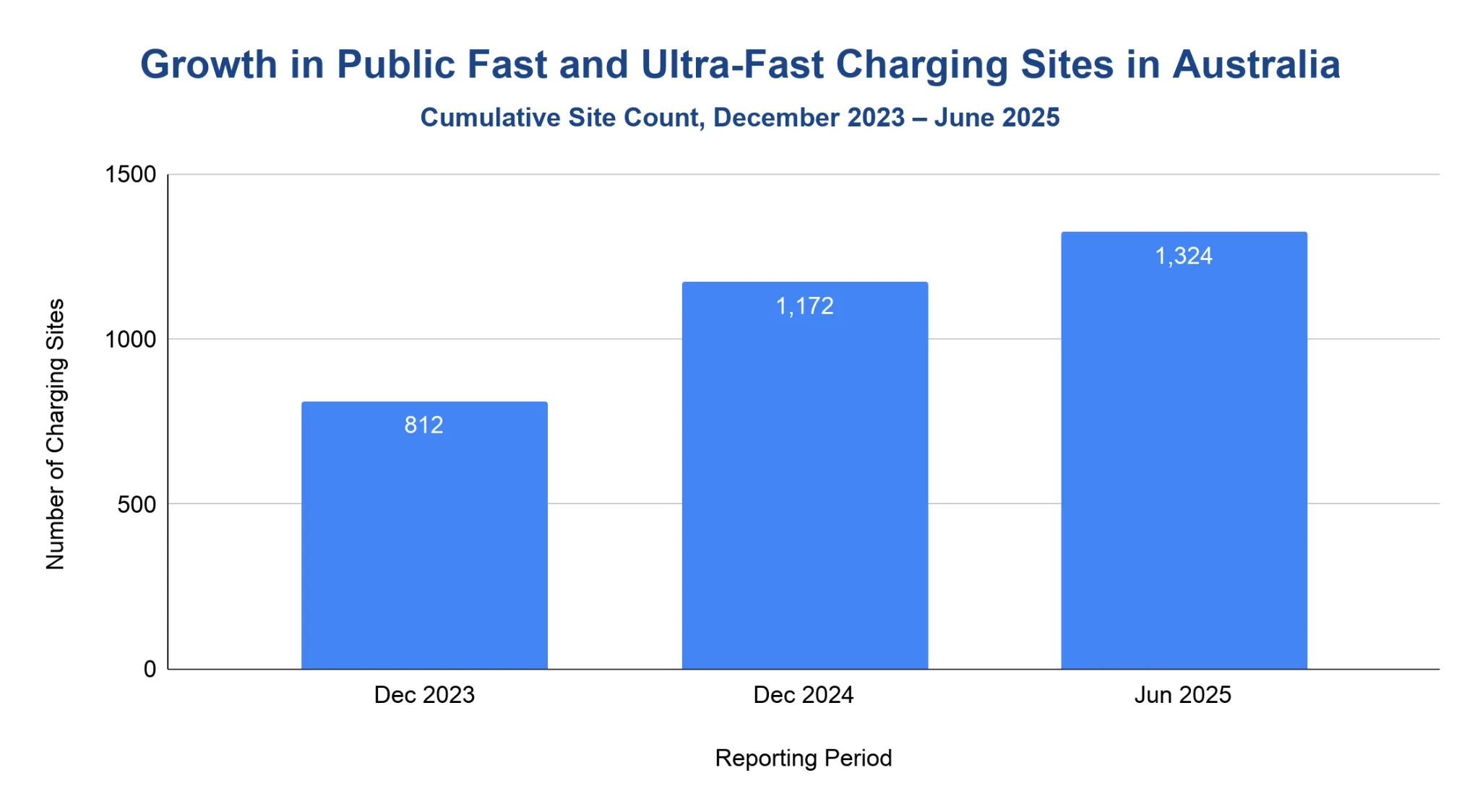
Australia had 1,324 public fast and ultra-fast charging sites with 4,138 fast and ultra-fast charging plugs by June 2025.
- Public fast and ultra-fast charging sites increased by 512 between December 2023 and June 2025.
- Most of that increase came during 2024, when the site count rose to 1,172, an increase of 360 sites from the previous year’s total of 812.
- A further 152 sites were added between December 2024 and June 2025.
- The fast and ultra-fast charging plug count increased by 21% from the same time one year earlier.
- Australia had about 45 EVs for every public charging plug as of December 2024.
- More than 360 thousand EVs were on Australian roads by June 2025.
What helps travelers choose electric rentals?
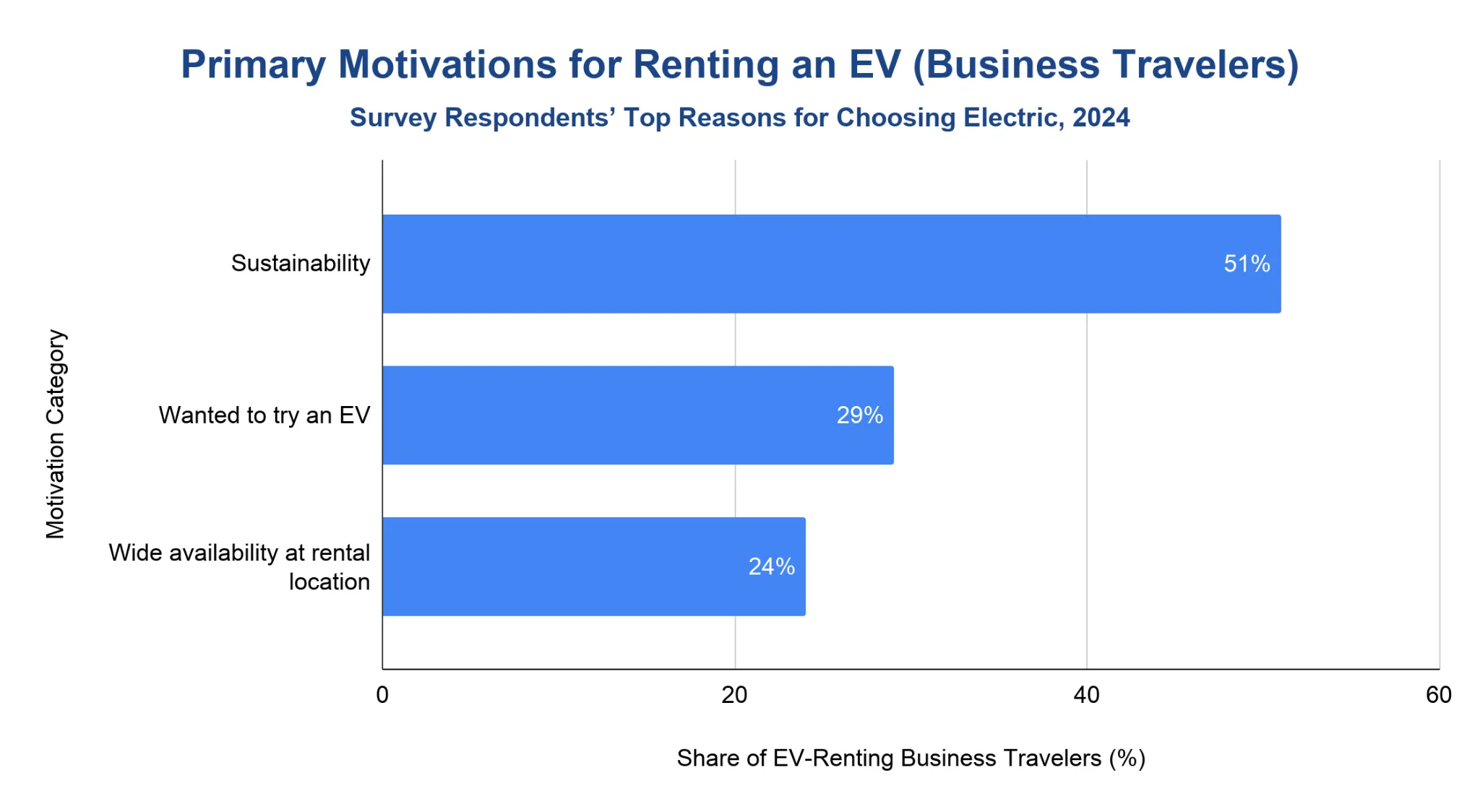
Among business travelers who rented EVs in a 2024 survey, sustainability was the top motivation, cited by 51% of EV-renting respondents.
- Sustainability was 22% ahead of wanting to try an EV.
- Wanting to try an EV was the second most common motivation, cited by 29% of EV-renting respondents.
- Wide availability at the rental location ranked third, cited by 24%.
- Across the broader surveyed business-traveler group, 81% said they never rent an EV on business trips.
- The main reported barriers were complex logistics (46%), low EV availability at the rental location (35%), and short range (33%).
- In Australia’s 2025 EV Ownership Survey, 1,839 EV owners participated between May and July 2025.
Note: The motivation percentages are shares of surveyed business travelers who had rented EVs. Business-traveler behavior does not represent all leisure renters, but it helps explain the role of availability, sustainability, and trial interest in EV rental decisions.
More Statistics
Outlook for Electric Car Rentals in Australia
Used EV sales in Australia exceeded 18 thousand in 2024-25, nearly double the roughly 9,400 used EVs sold in 2023-24.
- Used EV sales increased by at least 8,600 vehicles between 2023-24 and 2024-25.
- Used EV growth matters for electric rentals because rental vehicles often move into the used-vehicle market after fleet service.
- EVs reached 12.2% of new light vehicle sales in the first six months of 2025, above the 10.9% share recorded for 2024-25 overall.
- More than 360 thousand EVs were on Australian roads by June 2025.
- EV model availability reached 153 models by June 2025.
- Europcar’s ARENA-backed rollout supports at least 3,093 BEVs and 256 chargers across at least 41 Australian locations by 2028.
- SIXT’s 2023 BYD rollout added more than 500 EVs to the Australian rental supply pipeline.
Note: The 12.2% sales share means EVs as a share of all new light vehicle sales in the first six months of 2025. Used EV growth can help expand second-hand EV access after fleet vehicles leave rental service.
References
- Motor Vehicle Rental and Leasing Market Data (2014–2024) · ibisworld.com
- Electric Vehicle Charging Infrastructure Data (December 2023–June 2025) · dcceew.gov.au
- SIXT Australia: EV Fleet Announcement and Rental Pricing (2023) · sixt.com.au
- ARENA: Europcar EV Rental Fleet and Charging Rollout (2023-2028) · arena.gov.au
- evee: Peer-to-Peer EV Rental Price Guide · evee.com.au
- Avis Australia: EV Charging, Range, and Return Rules · avis.com.au
- Budget Australia: EV Rental Range Guidance · budget.com.au
- BITRE: Domestic Aviation Activity (2019, 2024-2025) · bitre.gov.au
- Tourism Spending Statistics - The Great Barrier Reef · Tourism Research Australia
- BCD Travel: Business Traveler EV Rental Survey (2024) · bcdtravel.com
- Electric Vehicle Council: EV Ownership Survey (2025) · Electric Vehicle Council
- Australian Taxation Office: Electric Car FBT Exemption Guidance (2022 onward) · ato.gov.au