

 Australia
 New Zealand
 Other Countries
 24/7 Support
Updated
Fuel costs in Australia vary due to factors like global oil prices, exchange rates, and government taxes, impacting transportation expenses nationwide.
Fuel Price Trend
What is the price of fuel in Australia in 2026?
- The average price for unleaded petrol in Australia in the week ending 23 August 2026 is AUD 201.6 cents per litre (cpl), while diesel costs on average AUD 248.3 cpl.1
How much does diesel cost in major Australian states/territories?
Prices are reported three ways: a national average, metropolitan prices covering the capital cities, and regional prices for everywhere else. Regional prices run higher, and the national average blends the two.
State-level fuel prices vary with regional petrol prices ranging from AUD 202.3 cpl in New South Wales/ACT to AUD 266.3 cpl in the Northern Territory on average in the week ending 23 August 20261.
- Regional diesel prices are highest in Northern Territory (AUD 289.9 cpl) and lowest in New South Wales/ACT (AUD 247.4 cpl).
- Metropolitan prices are lower and much closer together, averaging AUD 200.0 cpl for petrol and AUD 246.2 cpl for diesel. Sydney is cheapest on both at AUD 198.4 cpl and AUD 242.9 cpl, while Darwin is dearest for petrol at AUD 208.6 cpl and Darwin and Hobart are dearest for diesel at AUD 251.9 cpl and AUD 251.0 cpl.1
How do Australian fuel prices compare to global averages?
Australian fuel prices sit just above the global average — well below heavily taxed European markets such as Germany and the United Kingdom, but above the United States and Japan.
- As of 24 August 2026, the gasoline price in Australia is USD 1.45 per liter, compared to the global average of USD 1.42 per liter2.
| Country | Gasoline Price (USD/Liter) |
|---|---|
| Germany | 2.54 |
| United Kingdom | 2.21 |
| Australia | 1.45 |
| Global Average | 1.42 |
| United States | 1.17 |
| Japan | 1.07 |
Source · Prices as at 24 August 2026, converted to USD for global comparison.
What are the average annual prices for Fuel in Australia each year?
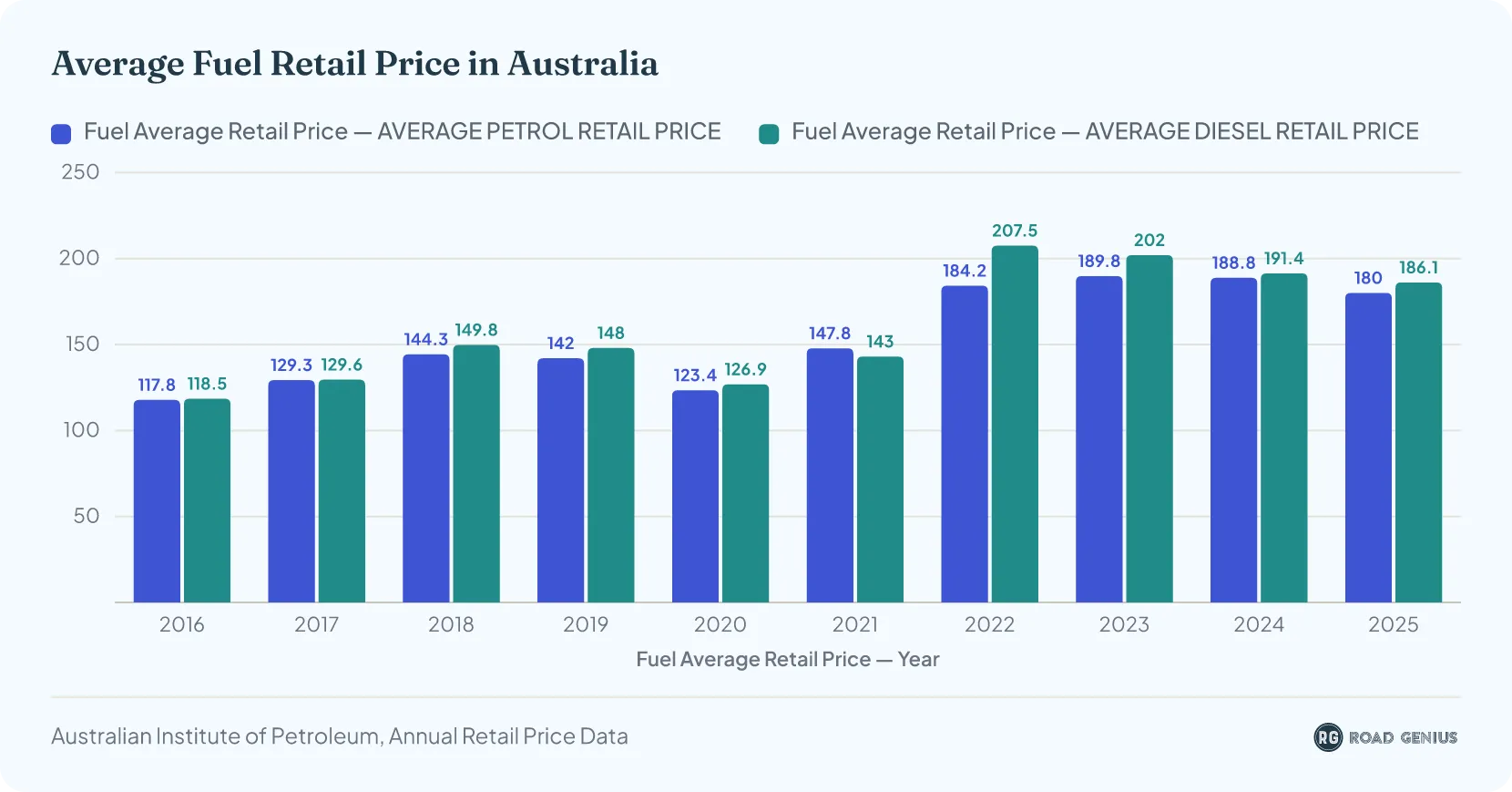
The annual average price for diesel in Australia in 2025 was AUD 186.1 cpl, while it was AUD 180.0 cpl for petrol.1
- Petrol Prices (2019 – 2025):
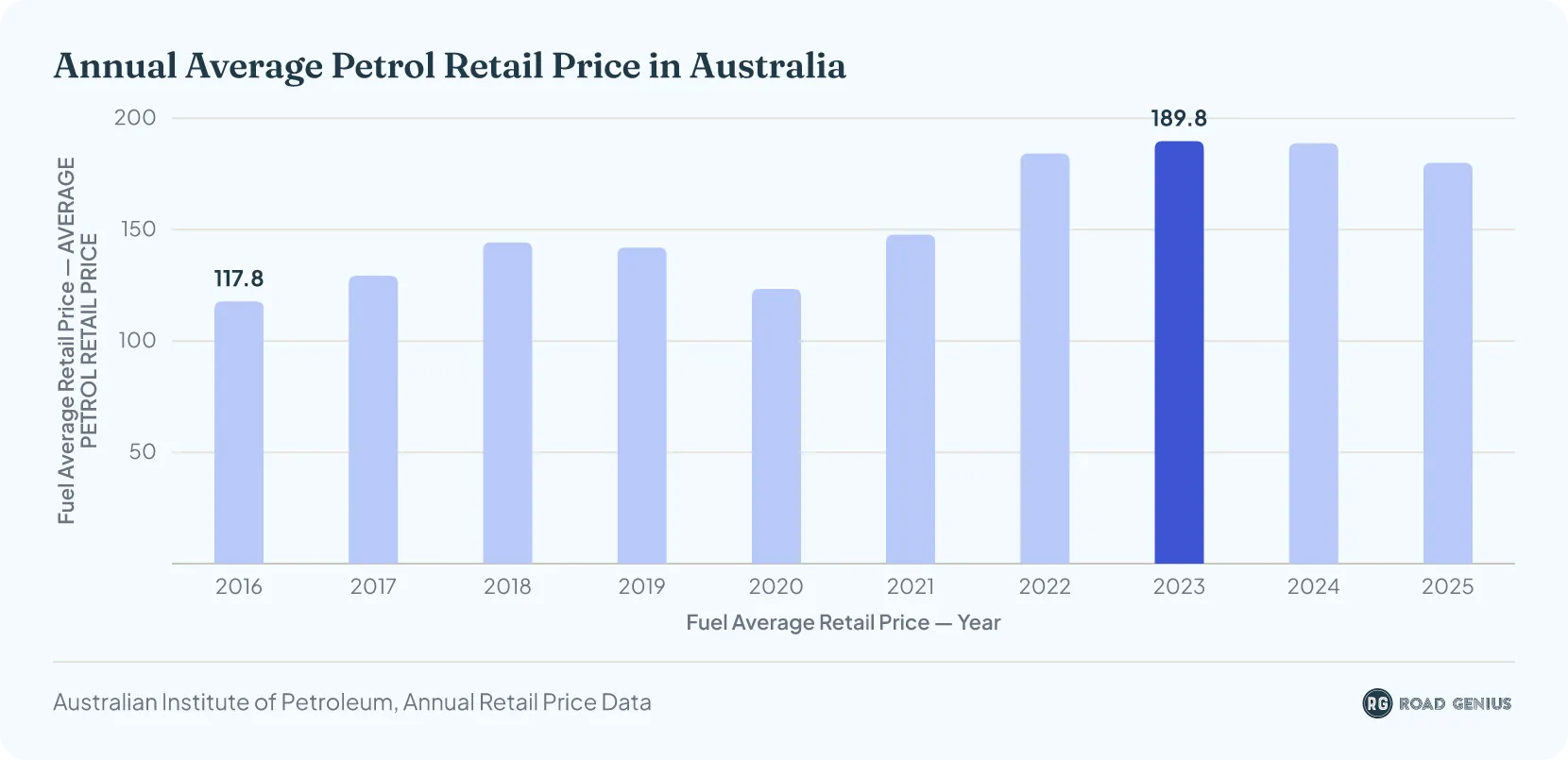
- In 2019, petrol prices were AUD 142.0 cpl. Due to the pandemic in 2020, prices decreased by 13%, dropping to AUD 123.4 cpl.
- A rising trend was observed in 2021, with prices reaching AUD 147.8 cpl, marking a 20% increase from the previous year.
- By 2022, petrol prices surged to AUD 184.2 cpl, a 24.6% increase, driven by global fuel supply chain disruptions.
- In 2023, prices peaked at AUD 189.8 cpl, marking a 3% increase from the previous year. 2024 saw a marginal decrease of less than 1%, settling at AUD 188.8 cpl1. 2025 brought a sharper fall of 4.6%, to AUD 180.0 cpl.
- Diesel Prices (2019 – 2025)
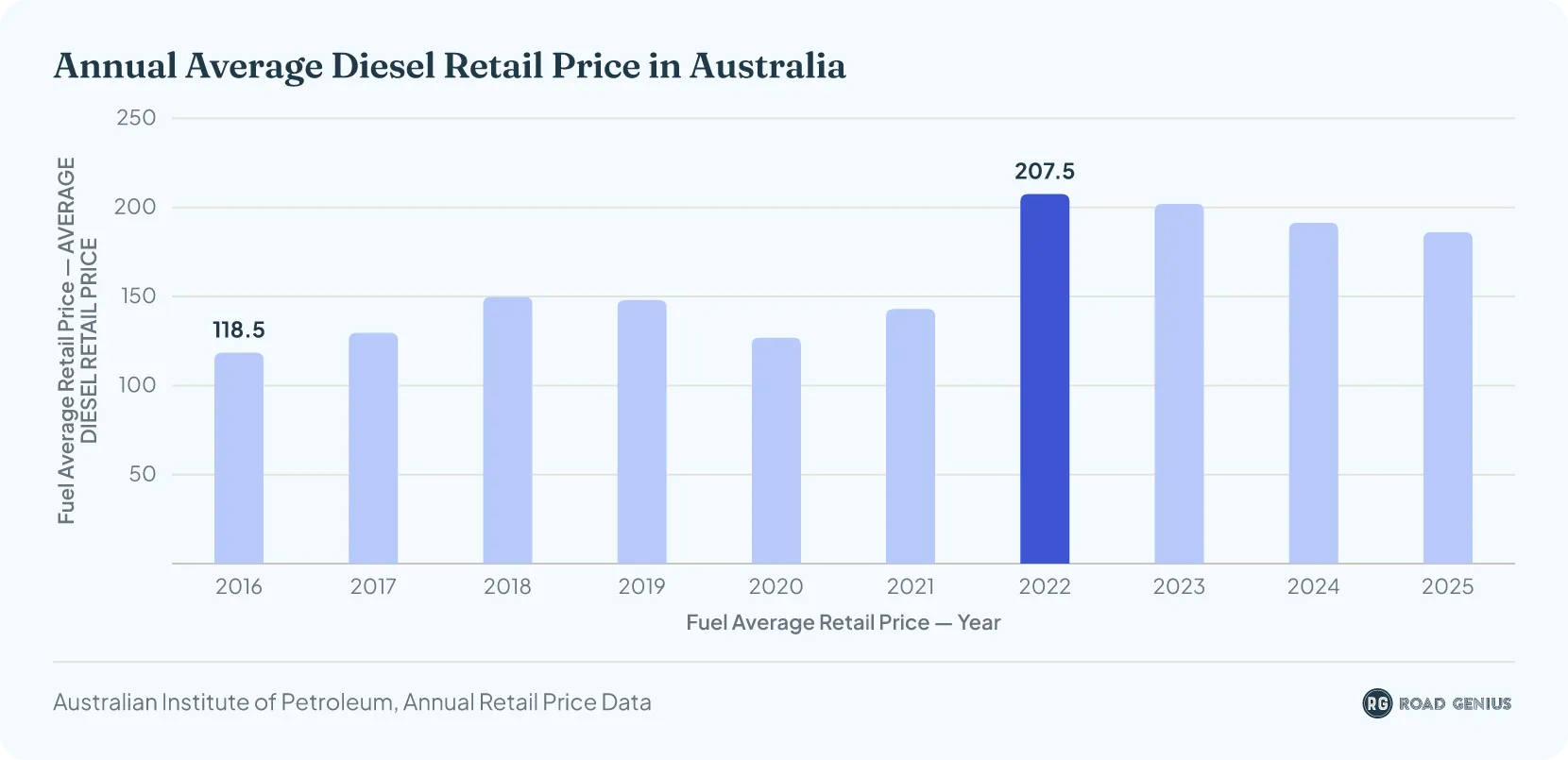
- In 2019, diesel prices stood at AUD 148.0 cpl. 2020 witnessed a decline of 14.2%, with prices falling to AUD 126.9 cpl.
- Diesel prices increased in 2021, rising 12.7% to AUD 143.0 cpl. An increasing trend was seen in 2022, reaching AUD 207.5 cpl, a 45.1% rise.
- In 2023, prices slightly dropped to AUD 202.0 cpl, a 2.6% decrease. 2024 saw a further reduction to AUD 191.4 cpl, reflecting a 5.2% decrease from the previous year.1 2025 brought a further 2.8% decrease, to AUD 186.1 cpl.
Which state has the most expensive fuel prices in Australia?
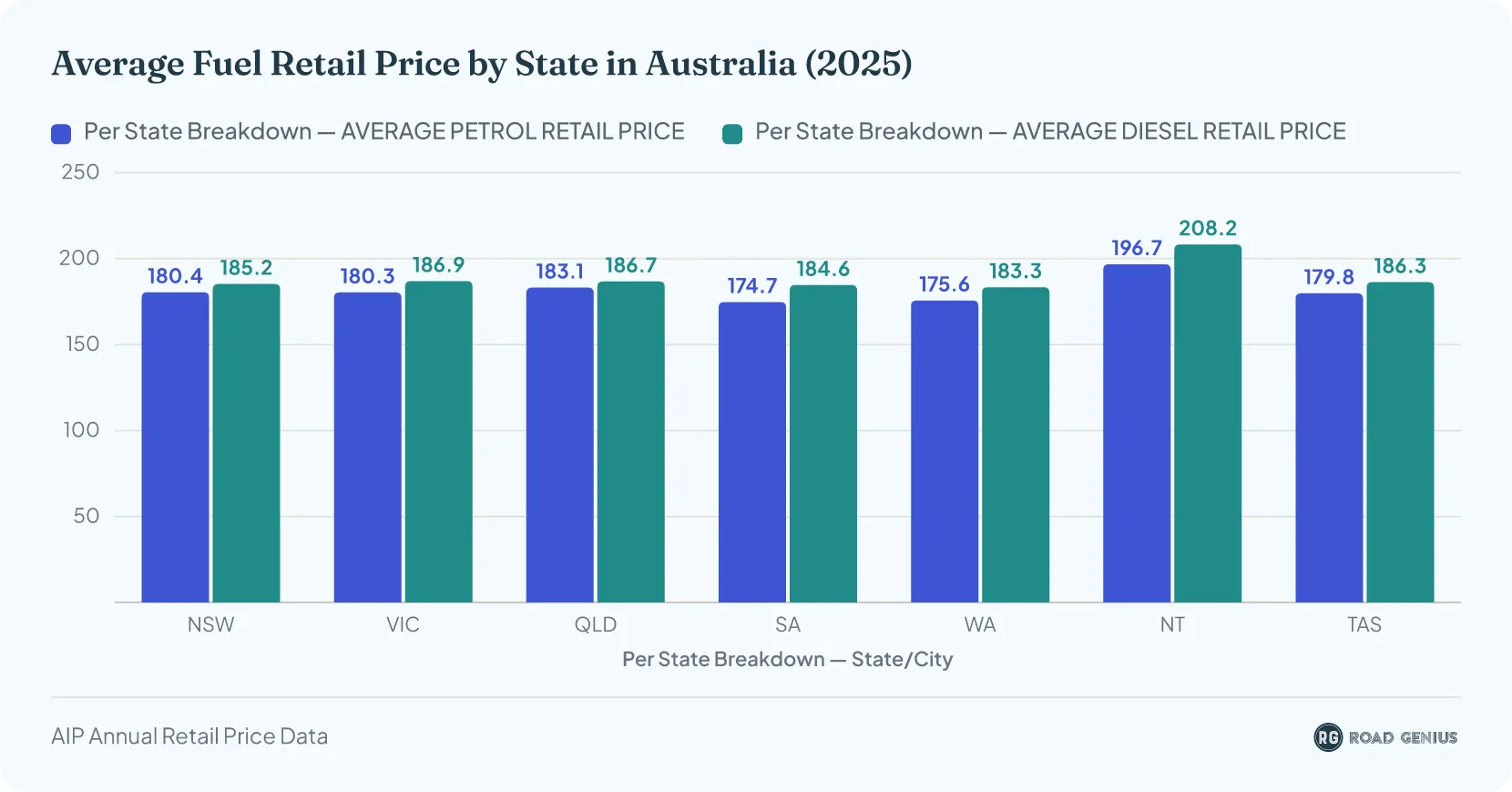
On full-year averages, the Northern Territory has the most expensive fuel for both petrol and diesel, at AUD 196.7 cpl for petrol and AUD 208.2 cpl for diesel across 20251. The figures below are annual averages, so they sit below the current weekly prices above.
Petrol Fuel
The Northern Territory (NT) had the highest petrol prices in Australia in 2025 at AUD 196.7 cpl, down 0.5% YoY, though still the highest largely due to limited competition and high transportation costs.
- Queensland (QLD) follows with AUD 183.1 cpl, a 4.6% decrease YoY, driven by fluctuations in refinery supply and fuel demand.
- New South Wales (NSW) sees petrol prices at AUD 180.4 cpl, reflecting a 5.2% decrease YoY, impacted by urban fuel demand and supply chain constraints.
Diesel Fuel
The Northern Territory (NT) has the highest diesel price at AUD 208.2 cpl, down 1.3% YoY, but still the highest reflecting high fuel transport and storage costs.
- Victoria (VIC) follows with AUD 186.9 cpl, a 2.5% decrease YoY, affected by fuel import costs and market constraints.
- Queensland (QLD) records AUD 186.7 cpl, decreasing 2.9% YoY, benefiting from regional fuel subsidies.
- New South Wales (NSW) sees diesel prices at AUD 185.2 cpl, with a 3.4% decrease YoY, due to stable refinery output.
Household Fuel Expenditures
What is the total fuel expenditure for Australian households each year?
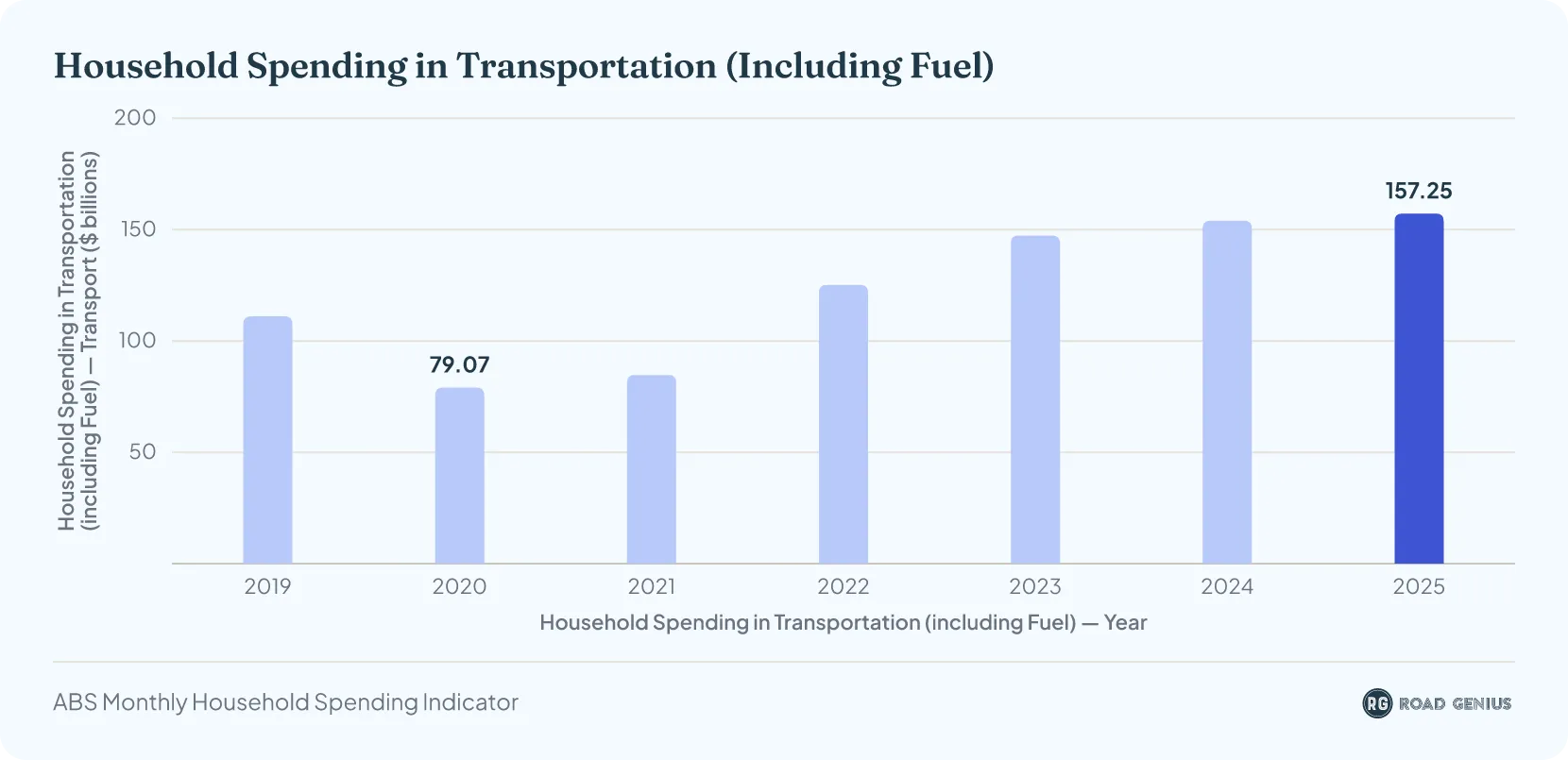
Total transportation costs for households in 2025 amounted to AUD157.25 billion3, as total fuel expenditure data for Australian households is not widely available
- In 2019, Australian households spent AUD $111.11 billion on transportation including fuel3. Due to the COVID-19 pandemic in 2020, spending dropped by 29%, reaching AUD79.07 billion as lockdowns reduced travel.
- Restrictions eased and fuel prices rose in 2021, transportation expenditure increased by 7.2%, reaching AUD $84.76 billion3.
- In 2023, continued inflation and high fuel prices contributed to a further 17.7% increase, with total spending reaching AUD 147.36 billion3.
- Household transportation expenditure rose to AUD 154.02 billion in 2024 (a 4.5% increase from 2023) and reached AUD 157.25 billion in 20253, driven by fluctuating fuel prices and economic recovery trends.
What percentage of Australian household expenditure is typically spent on transportation, including fuel?
- Transportation expenditure (including fuel) accounted for 17.0% of total household spending nationally in 2025, down from 17.4% in 20243.
| Year | Transport (AUD) | Total Spending (AUD) | % |
|---|---|---|---|
| 2019 | 111.11 B | 660.86 B | 16.8% |
| 2020 | 79.07 B | 627.57 B | 12.6% |
| 2021 | 84.76 B | 661.40 B | 12.8% |
| 2022 | 125.20 B | 792.49 B | 15.8% |
| 2023 | 147.36 B | 856.63 B | 17.2% |
| 2024 | 154.02 B | 884.66 B | 17.4% |
| 2025 | 157.25 B | 923.02 B | 17.0% |
Source · Calendar-year totals from the ABS Monthly Household Spending Indicator, July 2026 release.
More Statistics
 Car Ownership Statistics in Australia
 Road Trip Statistics in Australia
 Australia–UK Travel StatisticsEV Charging Stations in Canberra
 Uluru Tourism Statistics
 Whitsunday Islands Tourism Statistics
What is the average fuel cost for rental vehicles across major cities in Australia?
Fuel costs for rental vehicles vary by city, driven by local pump prices and vehicle efficiency. As of the week ending 23 August 2026:
- Adelaide has the highest average fuel price at 201.2 cpl1, leading to a cost of AUD 17.10 per 100 km.
- Brisbane and Melbourne follow closely with AUD 17.02 and AUD 17.00 per 100 km, respectively.
- Sydney is the cheapest among major cities, with fuel costing 198.4 cpl1—about AUD 16.86 per 100 km.
These estimates assume a rental vehicle consuming 8.5 L/100 km, a typical average for mid-sized cars.
Fuel adds close to AUD 17 per 100 km in every major city, making fuel-efficient vehicle choices more cost-effective, especially for longer journeys.
Government Policies and Fuel Price Regulation
How do Australian fuel regulations and taxes affect petrol prices?
- Australia’s fuel excise tax of AUD 53.7 cpl, in force since 3 August 2026, is lower than in many European nations.4
What is the outlook for future government policy regarding fuel pricing?
Future government policies are focused on reducing emissions through fuel efficiency standards, promoting alternative fuels like Electric Vehicles (EV), ensuring transparent and competitive fuel markets, and managing domestic gas supplies to stabilize prices.
- These initiatives are designed to support a transition towards cleaner energy sources while maintaining energy security and affordability for consumers.
References
- AIP Pump Prices — average weekly retail petrol and diesel prices by location, Australia · aip.com.au ↑ b c d e f g h i
- GlobalPetrolPrices — Australia gasoline prices and share of the world average · globalpetrolprices.com ↑
- ABS Monthly Household Spending Indicator — household spending, Australia · Australian Bureau of Statistics ↑ b c d e f
- ATO — Excise duty rates for fuel and petroleum products · ato.gov.au ↑